
In-House vs Outsourced Bookkeeping for Freight Companies
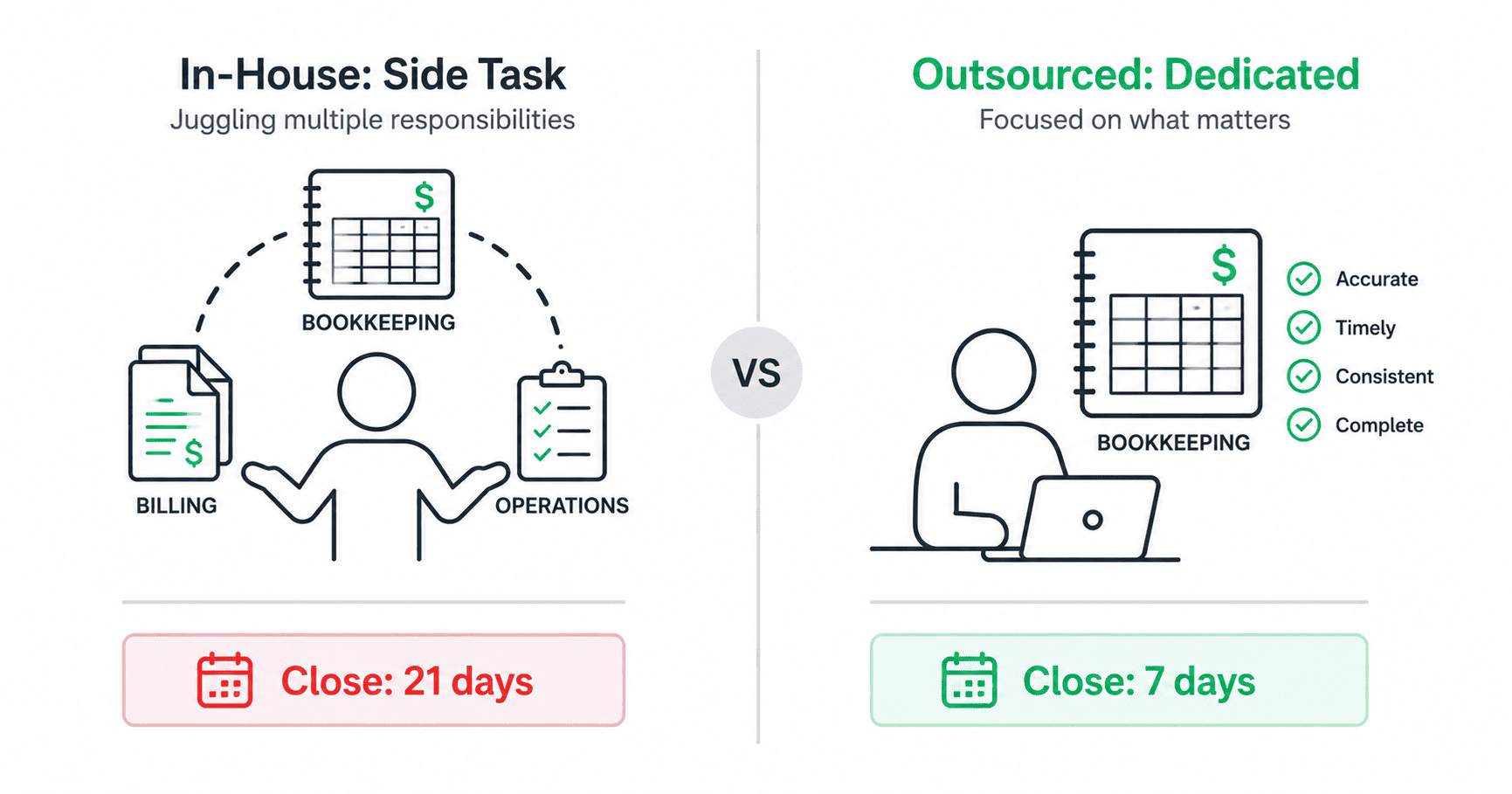
At most freight companies under $80 million in revenue, bookkeeping isn’t anyone’s primary job. It’s handled by the office manager between fires, the accounts receivable (AR) person on slow days, or the owner on weekends. The work gets done, eventually, but it competes with every other operational priority for attention.
This is the same pattern that plays out with every back-office function as freight companies grow: the work is important, the capacity isn’t there, and the function degrades gradually until something forces a change: a CPA scramble, a missed tax deadline, or financial data that doesn’t match reality.
This post compares in-house and outsourced bookkeeping for freight companies, not as a sales pitch for either model, but as an honest assessment of what each provides and where each falls short.
What Are the Advantages of In-House Bookkeeping?
In-house bookkeeping has genuine advantages when the company has the capacity to execute it properly.
Direct access to financial context. The in-house person sees transactions in context: they know that the $4,200 payment was for a specific carrier on a specific lane, that the $800 charge was a one-time equipment repair, that the unusual deposit was a refund from a canceled load. This context makes categorization faster and more accurate.
No communication overhead. The bookkeeper sits in the same office (or at least the same company) as the accounts payable (AP), AR, and operations teams. Questions about unusual transactions get answered immediately. There’s no lag between identifying a question and getting an answer.
Complete control over the process. The owner or controller can review the books at any time, adjust the chart of accounts structure, and make real-time changes to how transactions are categorized. There’s no service agreement to modify, no change request to submit.
These advantages are real. They’re also conditional: they only apply when the in-house person has enough dedicated time to do the work consistently. When bookkeeping is a side task competing with billing, AR, compliance, and daily operations, these advantages erode because the work doesn’t get done regularly enough to maintain them.
What Are the Challenges of In-House Bookkeeping at Growing Freight Companies?
The challenges mirror those of every shared back-office function.
Bookkeeping always loses the triage battle. When the back-office team is stretched (and at growing freight companies, the team is always stretched), bookkeeping is the function that gets deferred. A past-due invoice needs follow-up now. A carrier dispute needs resolution now. A shipper’s billing portal needs a corrected submission now. Bank reconciliation can wait until Friday. Then next Friday. Then month-end.
The skill set is specific. Bookkeeping requires someone who understands debits and credits, chart of accounts structure, reconciliation procedures, and the accounting software. Not every back-office person has this skill set. The office manager who’s great at operations management may not be comfortable with bank reconciliation. The AR specialist who’s excellent at collections may not know how to categorize expenses correctly.
The cost structure doesn’t fit the workload. A mid-size freight company might need 15-20 hours per week of bookkeeping work, not 40. Hiring a full-time in-house bookkeeper at $72,000-$85,000 fully loaded (base salary per BLS wage data for bookkeeping clerks, plus the benefits and payroll load on top) for 20 hours of weekly bookkeeping means paying for 40 hours of capacity that’s either underutilized (expensive) or filled with non-bookkeeping tasks (which means bookkeeping competes for attention again).
Turnover creates knowledge gaps. When the person doing bookkeeping leaves (and at freight companies, back-office turnover is meaningful), the books go unattended until a replacement is found, hired, and trained. The replacement needs to learn the chart of accounts, the categorization patterns, the reconciliation preferences, and any institutional context about how specific transactions should be handled. That ramp period can be 30-60 days, during which the books fall behind.
What Are the Advantages of Outsourced Bookkeeping?
The advantages center on dedicated capacity and consistency: the same dynamics that drive outsourcing of other back-office functions.
Dedicated focus. The outsourced bookkeeper does bookkeeping. Not billing. Not AR. Not compliance. Not whatever else needs attention today. The books get maintained consistently because the person responsible isn’t being pulled into operational fires.
The capacity matches the workload. Outsourced bookkeeping is typically priced by transaction volume, not by headcount. A freight company whose transaction volume needs 15 hours per week of bookkeeping pays for that volume, not for 40 hours. The cost structure fits the actual workload.
No coverage gaps. When the outsourced bookkeeper is unavailable (vacation, sick), the provider covers through team depth. The books don’t go unattended for two weeks while someone is on PTO.
Connected to AP and AR data. For freight companies that already outsource AP invoice verification and AR follow-up, outsourced bookkeeping from the same team means the transaction data flows continuously from operations into accounting. No handoff gap. No monthly data export. The team that processed the carrier payment records it in the same workflow.
Month-end close in 7 days becomes the standard, not the exception, because the books are kept current throughout the month by a team with no competing priorities.
What Are the Challenges of Outsourced Bookkeeping?
Less immediate context. The outsourced bookkeeper doesn’t sit in the office. They may not immediately know that the $4,200 payment was for a specific one-time situation. This is managed through communication protocols: flagging unusual transactions for client input, maintaining notes on recurring items, and building familiarity over the first 60-90 days of the engagement.
Accounting software access. The outsourced team needs login access to the client’s accounting software. For some companies, giving external access to financial systems raises security concerns. These are addressed through access controls, audit trails, and defined permission levels, but the concern is legitimate and should be discussed during setup.
Dependency on a third party. As with any outsourced function, the company depends on the provider to perform consistently. If the provider’s quality degrades, the books degrade. This risk is managed through monthly deliverables, reconciliation accuracy metrics, and defined SLAs.
When Does Each Model Make Sense?
In-house bookkeeping makes sense when the company has a dedicated bookkeeper (not a shared role) with enough capacity and skill to maintain the books consistently. If bookkeeping is someone’s primary job and they’re good at it, the in-house model works.
One more factor belongs in this decision. When owners, a board, or a lender expect reporting from someone other than the person keeping the books, independence stops being a preference and becomes a requirement. That is a different job from bookkeeping, and it falls under ownership and transaction reporting.
Outsourced bookkeeping makes sense when bookkeeping is currently a side task that gets deferred, when the company needs 15-20 hours per week of bookkeeping (not a full-time headcount), when the company already outsources other back-office functions and wants the data connection, or when month-end close is consistently late and the books aren’t current.
The hybrid (an in-house controller who oversees financial strategy and a client CPA relationship, with outsourced bookkeeping handling the daily recording and reconciliation) works for freight companies that want strategic financial oversight in-house without the cost of a full-time bookkeeper.
ClearLane’s bookkeeping service is available as an add-on to any service package, priced by monthly transaction volume.
Frequently Asked Questions
It depends on current capacity. If bookkeeping is a dedicated function with the right skill set and enough time, in-house works. If it’s a side task that gets deferred, outsourcing provides the dedicated focus that keeps books current.
Outsourced bookkeeping is priced by transaction volume, matching cost to workload. A freight company whose transaction volume needs 15-20 hours of work a week pays for that volume, not the $72K-$85K fully loaded cost of a full-time in-house hire who may be underutilized or pulled into other tasks.
Yes, this hybrid is common. The controller owns financial strategy and CPA relationships. The outsourced bookkeeper handles daily recording and reconciliation. The controller gets clean, current data without spending time on transaction-level work.
When the same team handles AP, AR, and bookkeeping, transaction data flows continuously from operations into the accounting system. No handoff gap, no monthly export, no reconciliation backlog.
Running the in-house vs outsourced bookkeeping numbers for your own operation? Talk to our team to walk through it. Or email us at info@getclearlane.com.
Related reading: month-end close for freight companies and outsourced bookkeeping vs your CPA. Scope is set out on the bookkeeping page.