
Technology Adoption in Freight: What’s Working and What’s Hype
Why Has Technology Investment Not Solved the Freight Back-Office Bottleneck?
The freight industry has invested heavily in technology over the past decade. TMS platforms have become more capable, more integrated, and more accessible to mid-size operators. Visibility tools track loads in real time. Digital freight matching connects shippers and carriers through algorithms and marketplaces. Document management systems organize PODs, BOLs, and carrier documentation. Automation rules handle routine data matching. Carrier compliance databases provide access to FMCSA data, insurance filings, and safety records.
The investment has produced real improvements. Load booking is faster. Tracking is more transparent. Data is more accessible. Systems are better integrated.
And yet, the back-office bottleneck persists at most growing freight companies. Billing teams are still the bottleneck. PODs still take too long to retrieve. Carrier invoices still have errors that go undetected. Accessorial charges still get missed. DSO still creeps up as companies grow. Accounts receivable (AR) aging still drifts into the 60-day and 90-day buckets.
The question worth examining is why: not to dismiss technology’s value, but to understand what it does and doesn’t solve, so that freight companies can invest in the right combination of tools and people.
What Does Freight Technology Actually Do Well?
Technology excels at three categories of work in the freight back-office.
Data organization and access. A modern TMS stores load data, rate confirmations, carrier information, and billing records in a structured, searchable format. The billing team can pull up any load’s documentation in seconds. The accounts payable (AP) team can access rate confirmations without digging through email. The compliance team can check carrier status through integrated databases. This is a genuine improvement over the era of spreadsheets, email folders, and paper files, and it’s foundational to everything else.
Rule-based automation for standard scenarios. TMS automation rules can handle routine data matching: carrier invoices that exactly match the rate confirmation, standard fuel surcharge calculations, automatic billing triggers based on POD receipt, and routine compliance checks against FMCSA databases. These automations reduce manual work on the loads that follow the standard path.
Reporting and visibility. Technology provides dashboards, aging reports, DSO calculations, carrier performance metrics, and billing cycle analytics that would be impractical to compile manually. The data visibility enables better decision-making: if you can see that POD turnaround is trending from 24 hours to 48 hours, you can act before it becomes a DSO problem.
These are real capabilities that improve efficiency and decision quality. No freight company should be operating without them.
What Can’t Freight Technology Automate in Back-Office Operations?
Technology has clear limitations in the freight back-office, and understanding these limitations is essential for realistic planning.
Technology doesn’t handle exceptions. Freight is an exception-heavy business. Rate confirmation discrepancies that don’t fit standard matching rules. Carrier invoices with accessorial charges that need to be verified against specific contract terms. PODs that are partial, unclear, or for the wrong load. Documentation that’s missing from the carrier’s portal and requires a phone call to retrieve.
Each of these exceptions requires a human to evaluate the situation, make a judgment, and take an action. Automation rules handle the 70-80% of loads that follow the standard path. The remaining 20-30% (the exceptions) require human intervention. And as load volume grows, the total number of exceptions grows with it, even if the exception rate stays constant.
At 3,000 loads per month with a 25% exception rate, that’s 750 loads per month requiring human judgment. At 15 to 30 minutes per exception, that’s 188 to 375 hours of manual work monthly, roughly one to two full-time employees dedicated entirely to exception handling.
Technology doesn’t create capacity for workflow execution. A TMS can flag that a POD is missing. It can’t call the carrier to get it. A document management system can store a lumper receipt. It can’t track down the driver who has the receipt in their truck. An automation rule can match a standard carrier invoice. It can’t resolve a discrepancy that requires pulling the rate confirmation and checking each line item.
The workflow execution gap (the human work of chasing, verifying, resolving, and following up) is the bottleneck that technology organizes but doesn’t eliminate. Better tools make the work more efficient (the POD team can check portals faster, the billing team can access data faster), but they don’t create the person-hours needed to do the work.
Technology doesn’t replace relationship-dependent communication. Following up with a shipper about a past-due invoice requires understanding the relationship context, choosing the right communication channel, and adjusting the tone based on the customer’s importance and history. Escalating a carrier compliance issue requires judgment about the carrier’s value to the network versus the risk they represent. Negotiating a billing dispute resolution requires understanding what the shipper will accept.
These interactions are human, and they’re a significant portion of the back-office workload, especially as the company grows and the customer and carrier base expands.
Where Is the Gap Between Freight Technology and Back-Office Execution?
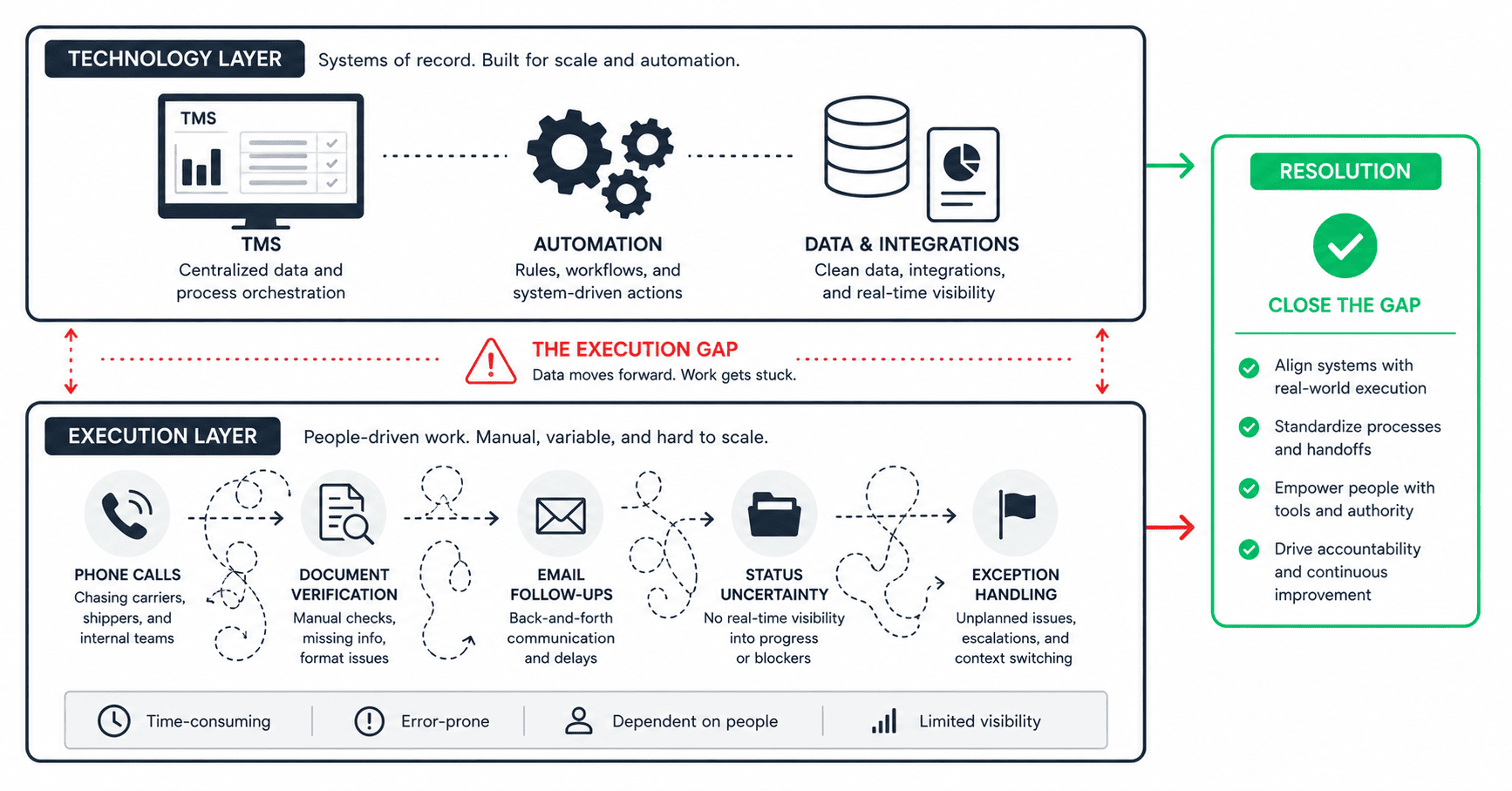
The freight technology market has focused primarily on the data layer, making information more accessible, more structured, and more integrated. That’s valuable. But the execution layer (the human work of processing that data, handling exceptions, and communicating with carriers and shippers) hasn’t received the same investment.
The result is a common pattern at growing freight companies: the TMS is excellent, the data is available, the automation handles the routine, and the back-office team is still overwhelmed, because the execution workload that technology can’t automate is substantial and growing with volume.
This gap explains why freight companies with modern, well-configured TMS platforms still have POD turnaround issues, billing accuracy problems, and DSO inflation. The technology is working. The team is working. There just aren’t enough people doing the execution work to keep pace with the volume of exceptions, verifications, communications, and follow-ups that the data generates.
What Actually Fixes the Bottleneck
The freight companies that successfully scale their back-office operations invest in both technology and execution capacity, recognizing that each solves a different part of the problem.
Technology solves the data problem. A well-configured TMS, integrated document management, automation rules for standard scenarios, and compliance databases provide the foundation. Without these, the execution team is working with poor tools. The technology investment is table stakes.
Execution capacity solves the workflow problem. Dedicated teams, whether in-house or outsourced, provide the person-hours needed to process the work that technology can’t automate. POD retrieval at volume. Carrier invoice verification with exception handling. Pre-billing audits on every load. Shipper billing with customer-specific requirements. AR follow-up on a structured daily cadence. Carrier compliance monitoring at defined intervals.
The combination of technology and execution capacity is what closes the bottleneck. Technology without enough people creates well-organized data that sits unprocessed. People without good technology create manual work that’s slower and more error-prone than it needs to be.
Evaluating Technology Claims
When freight technology vendors claim their product will “automate” billing, AR, or back-office operations, the evaluation should be specific.
What percentage of loads will the automation handle without human intervention? If the answer is 70-80% of standard loads, that’s realistic and valuable: it frees the team to focus on the 20-30% that need attention. If the answer is implied to be 100%, that’s overstated: freight exceptions will always require human judgment.
Does the technology create capacity or organize existing capacity? A tool that reduces the time to process an invoice from 15 minutes to 10 minutes cuts processing time by a third, which is real and meaningful. But it doesn’t eliminate the need for someone to spend those 10 minutes. At 3,000 loads per month, the team still needs 500 hours of billing capacity even at the improved efficiency rate.
What happens when the automation fails or encounters an exception? The exception handling workflow is as important as the automation itself. A tool that processes 80% of invoices automatically and dumps the other 20% into an unstructured exception queue hasn’t solved the problem. It’s sorted it into two piles, one of which still needs full human attention.
Technology Plus Capacity
The freight companies that navigate back-office scaling successfully treat technology and execution capacity as complementary investments, not substitutes.
The technology provides the data foundation, the automation for standard work, and the visibility into metrics and trends. The execution capacity provides the person-hours to handle the volume of exceptions, verifications, and communications that the technology surfaces but can’t resolve.
ClearLane operates within this framework, working inside the freight company’s existing TMS, using their established data systems and automation rules, and providing the dedicated execution capacity for the post-dispatch pipeline functions that technology can’t automate: POD retrieval, carrier invoice verification, pre-billing audit, shipper billing, carrier compliance monitoring, and AR management.
Frequently Asked Questions
Technology solves the data problem (access, organization, automation of standard scenarios) but not the workflow execution problem. At 3,000 loads per month, 20-30% of loads require human judgment that technology can’t automate: exception handling, relationship communication, and verification decisions.
Roughly 70-80% of routine work can be handled by TMS automation rules, document management, and standard matching. The remaining 20-30% (exceptions, complex verifications, customer and carrier communications) requires human execution.
Because the TMS organizes the data but doesn’t create the person-hours needed to process it. Someone still has to chase PODs, verify carrier invoices, catch billing errors, and follow up on AR. The execution gap is the bottleneck, not the data gap.
Technology and execution capacity are complementary investments, not substitutes. Technology provides the data foundation and automation. Dedicated teams provide the person-hours for the exception handling and workflow execution that technology can’t automate.
Want execution capacity behind the tools you already run? Talk to our team to walk through it. Or email us at info@getclearlane.com.