
In-House vs Outsourced Carrier Invoice Audit: An Honest Cost Comparison
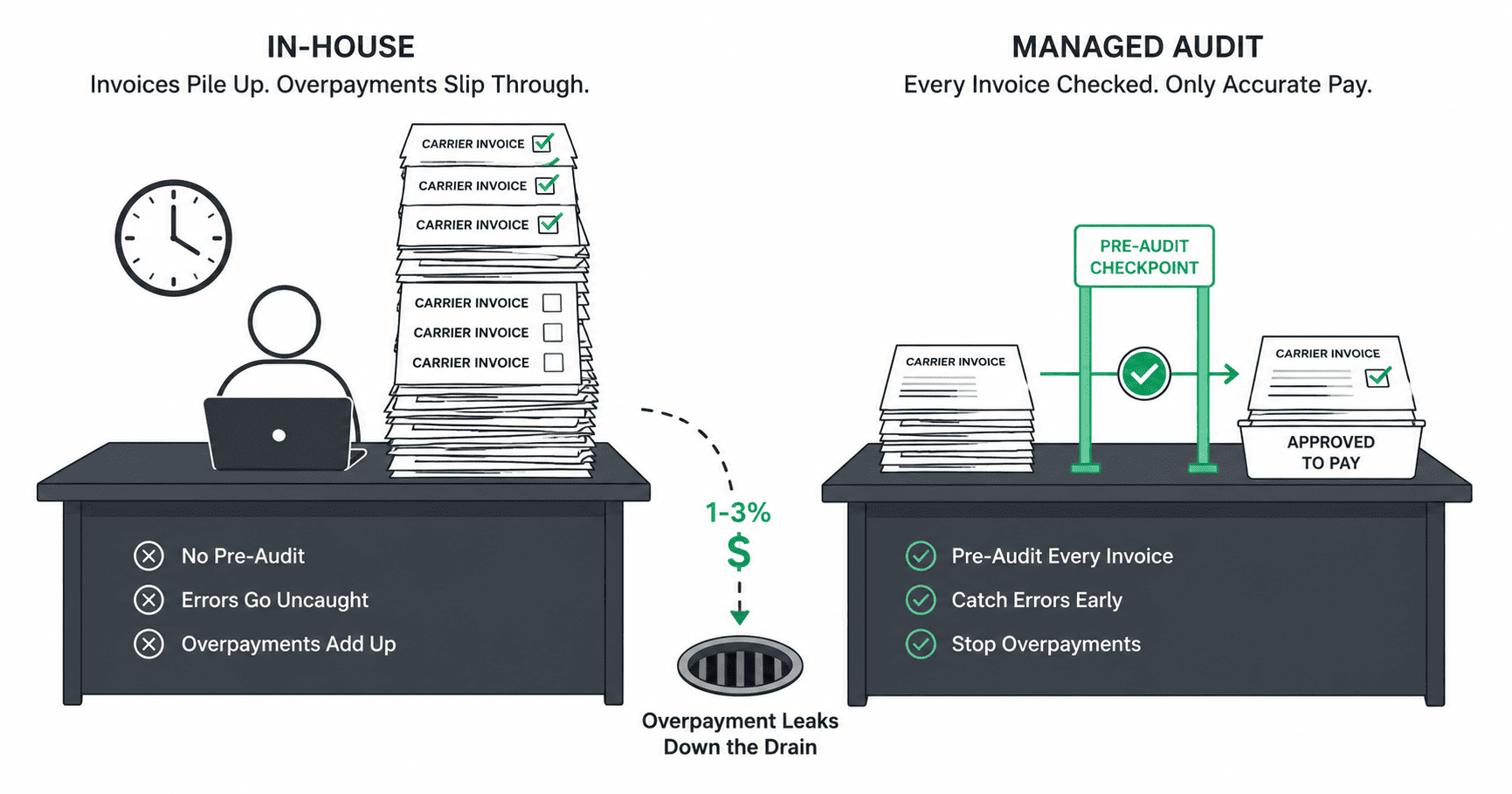
Every freight company audits carrier invoices. The question is whether it happens by design or by accident. When invoices are paid as billed, in our experience accounts payable (AP) overpayment runs 1-3% of carrier spend. On $2M a month with carriers, that is $240,000 to $720,000 a year leaving quietly. What the audit checks line by line is covered in the freight audit and payment guide. This post compares the two honest ways to stop it: building an audit desk in-house or handing the function to a managed service.
Why does carrier invoice auditing get skipped in-house?
Nobody decides to skip it. It erodes. At low volume, the person paying carrier invoices knows the loads and catches the obvious errors. As volume grows, the same person is racing payment terms, quick-pay discounts, and factoring notices. Deadline pressure rewards approving, not checking. The result is a desk that audits the invoices that look wrong and waves through the ones that look normal, and rate discrepancies rarely look wrong at a glance.
The checks themselves are not complicated. The freight invoice audit checklist fits on one page. The problem is running twelve checks on every invoice, every day, at volume, without letting the payment queue back up.
What does a real in-house audit desk cost?
A dedicated AP auditor runs $75,000 to $95,000 a year fully loaded, and one person covers roughly 1,000 to 2,000 loads a month before the queue wins. Add the hidden lines: recruiting and training time, coverage for vacations and turnover, and the months a new hire spends learning which carriers pad accessorials. The full cost structure of in-house staffing is consistently underestimated because most of it never appears on the AP budget line.
In-house also has real advantages: the auditor sits next to dispatch, knows the shippers, and can walk over to ask about a detention claim. For operations with stable volume and low turnover, a disciplined in-house desk works.
What does outsourcing the audit change?
A managed audit service puts a dedicated team on every invoice before payment, with the checks standardized and the volume problem absorbed by the provider. Cost scales with the engagement instead of jumping a full salary at a time. Coverage does not take vacations. And because the service works inside your TMS and payment process, the deliverable is an approved-to-pay file, not homework.
What you give up is proximity. The audit team is not in your dispatch room, which is why documentation standards matter more: rate confirmations, detention times, and lumper receipts have to live in the systems, not in someone’s memory. Operations with clean paperwork transition easily. Operations that run on tribal knowledge feel the gap first, and usually discover the paperwork problem was costing them money anyway.
How do the costs actually compare?
Side by side, on the dimensions that actually decide it:
| Factor | In-house audit desk | Managed audit service |
|---|---|---|
| Base cost | $75,000-$95,000 per auditor, fully loaded | Scales with the engagement, no salary step |
| Coverage | Roughly 1,000-2,000 loads a month per person | Volume absorbed by the provider |
| Ramp time | Several months to learn every carrier and lane | About 2 weeks of process mapping, then a month of parallel running |
| Vacation and turnover | Queue stops, or someone unqualified covers | Provider problem, not yours |
| Audit standard | Depends on the person | Standardized checks on every invoice |
| When volume doubles | Second hire, second ramp | Engagement scales, same standard |
| Institutional knowledge | Walks out with the employee | Documented in the process |
Worked example. A brokerage moving 1,500 loads a month at $1,300 average carrier cost pays carriers about $1.95M a month. At a 1-3% overpayment rate, $19,500 to $58,500 a month is going out the door that should not be. One auditor at $85,000 fully loaded costs about $7,100 a month and covers this volume, barely, with no backup. If the desk catches even half the leak, it pays for itself; the risk is that one person under deadline pressure rarely catches half. The AP overpayment calculator runs this arithmetic on your own numbers.
Two things the table cannot show. Salary bands vary by market: BLS wage data puts the base salary for accounting and auditing clerks well below the loaded figure above, and the difference (benefits, payroll taxes, software, supervision) is exactly the part most budgets miss. And a managed service quote depends on scope, which is why this post compares structures rather than quoting a number.
When does each model make sense?
Under roughly 1,000 loads a month: stay in-house, but make the audit a named responsibility with the checklist as the standard, not a side task. From 1,000 to 3,000 loads: the math starts favoring a dedicated desk, and the build-or-buy question is real; run your numbers through the AP overpayment calculator before deciding. Above 3,000 loads: an unaudited AP desk is a standing budget leak, and the only question is whether the dedicated desk is on your payroll or a managed carrier invoice audit.
The wrong answer at any volume is the default: invoices paid as billed because everyone is busy.
What does switching to a managed audit actually look like?
The first two weeks are mapping, not auditing. Where do rate confirmations live, who approves accessorials, what are the payment terms by carrier, and which shippers require backup with every invoice. Operations with clean documentation move through this fast. Operations that run on memory discover their real problem here, and fixing it pays off whether they outsource or not.
Then comes a parallel run. Your desk keeps paying invoices the way it always has while the audit team works the same invoices ahead of payment. Every discrepancy goes on a log: the duplicate from a carrier that rebills when payment takes 40 days, the fuel surcharge calculated on the wrong week, the detention claim with no timestamps behind it. After a month, that log is not a sales pitch. It is your own data telling you what unaudited AP was costing.
One thing that surprises owners: nobody has to lose a job. The person who was paying invoices under deadline pressure usually moves to work that actually needs their judgment: collections, carrier relations, or dispute handling. Paying bills fast was never the best use of someone who knows your freight.
What results are reasonable to expect?
In the first 90 days: duplicates stop immediately, because they are the easiest catch. The 1-3% overpayment rate compresses as fuel surcharge and accessorial errors get caught before payment instead of discovered after. The working target is 99%+ invoice accuracy, measured the way our methodology page defines it: on invoices received, not on a sample. On $2M a month of carrier spend, closing even the bottom of that range is $240,000 a year that stops leaving.
The honest caveat: the first month often looks worse before it looks better, because the audit surfaces documentation gaps your old process papered over. Missing lumper receipts and unlogged detention times show up as flagged invoices. That is not the audit creating problems. It is the audit finding them while the money is still in your account.
Frequently asked questions
Budget a loaded cost of $75,000 to $95,000 per person annually for a dedicated AP auditor, plus the ramp time to build carrier knowledge. Below roughly 1,000 loads a month, the role is usually a shared duty rather than a dedicated seat, which is where audit quality slips.
A managed audit checks every invoice against the rate confirmation before payment: line-haul, fuel surcharge, accessorials with documentation, duplicates, and remit-to details. The deliverable is an approved-to-pay file, not a report you still have to act on.
Yes, and it is a common split. Your team keeps payment release and carrier relationships in-house while the audit desk verifies each invoice against the rate confirmation and flags discrepancies before payment. You approve what has already been checked, so control stays with you and the checking burden does not.
Want the audit run for you, on every load, before payment? Request a demo. Or email us at info@getclearlane.com.