
Bank Reconciliation for Freight Companies: Why It Falls Behind and How to Fix It
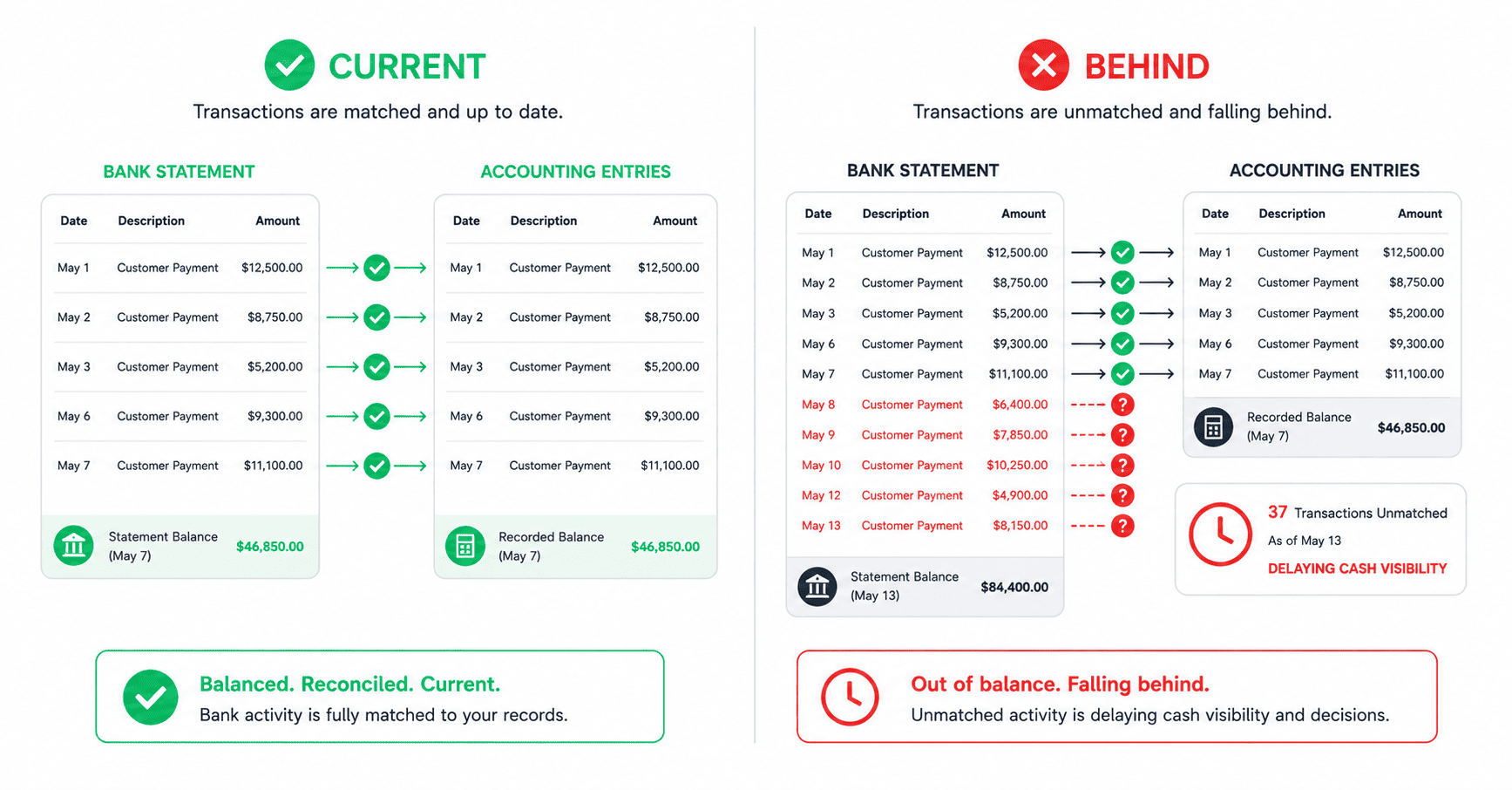
Bank reconciliation is the most fundamental bookkeeping task, matching every transaction in the bank account against the corresponding entry in the accounting system. It sounds simple. For freight companies with high transaction volumes, it’s also the task most likely to fall behind.
A freight brokerage processing 3,000 loads per month generates hundreds of bank transactions every month: carrier payments, shipper receipts, fuel purchases, insurance premiums, software subscriptions, office expenses, and dozens of other categories. Each transaction in the bank account should match an entry in the accounting system. When reconciliation is current, discrepancies are caught within days. When it falls behind, discrepancies compound and the catch-up effort grows exponentially.
Why Does Bank Reconciliation Fall Behind at Freight Companies?
The pattern is predictable. Bank reconciliation is important but not urgent. It doesn’t have a customer waiting for it. It doesn’t have a carrier on the phone about it. It doesn’t have a deadline attached to it, until the CPA asks for data or the owner discovers the books haven’t been reconciled in six weeks.
At freight companies where bookkeeping is a side task, bank reconciliation competes with every operational priority for the same person’s time. When a shipper dispute needs resolution, when a carrier invoice needs verification, when a POD needs to be chased, bank reconciliation waits.
The second factor is transaction volume. A brokerage doing $3 million in monthly billings with hundreds of carrier payments per month generates a high volume of bank activity. Matching each transaction requires pulling the corresponding invoice, payment, or receipt from the accounting system. At volume, this is hours of work per week, and when it’s batched monthly instead of done weekly, it becomes days of work per month.
The third factor is complexity. Freight company bank accounts have transaction types that don’t always match one-to-one with accounting entries. A single carrier payment might cover three loads. A shipper payment might cover a batch of 15 invoices. Factoring advances, wire fees, bank charges, and ACH returns all need identification and categorization. Each exception takes time, and at volume, exceptions accumulate.
What Happens When Reconciliation Falls Behind?
The consequences are cumulative and increasingly expensive the longer reconciliation is deferred.
Errors go undetected. A duplicate carrier payment, a bank fee that shouldn’t have been charged, a deposit that doesn’t match any invoice: these discrepancies are easy to identify when reconciliation is current (days old). When reconciliation is weeks or months behind, the same discrepancies are buried in hundreds of other transactions and may not be found until the CPA’s year-end review.
The accounts payable (AP) verification process loses its feedback loop. When bank reconciliation is current, carrier overpayments and duplicate payments show up quickly: the bank shows a payment that doesn’t match an approved invoice. When reconciliation is behind, those overpayments sit in the bank account undetected.
Cash flow visibility degrades. The owner or controller can’t see an accurate cash position if the bank account and accounting system don’t match. Decisions about carrier payment timing, factoring usage, and capital allocation are based on incomplete data.
Month-end close becomes a reconstruction project instead of a verification exercise. The 7-day close benchmark is impossible when bank reconciliation is weeks behind, because the close can’t happen until the reconciliation is caught up.
How Do You Keep Bank Reconciliation Current?
The fix is frequency, not effort. Daily reconciliation takes 15-30 minutes per session, and weekly reconciliation 1-2 hours, because the transaction volume is small and the context is fresh. Monthly reconciliation of the same transactions takes 8-12 hours because the volume has accumulated and the context is stale.
Daily reconciliation is the gold standard for high-volume freight companies. Every morning (or every evening), new bank transactions are matched against accounting entries. Discrepancies are flagged and resolved the same day. The daily effort is 15-30 minutes for most mid-size brokerages.
Weekly reconciliation works for lower-volume operations (under 1,500 loads per month). Once per week, all bank transactions from the past seven days are matched and reconciled. The weekly effort is 1-2 hours.
Monthly reconciliation is where problems start. At 3,000 loads per month, a full month of unreconciled bank transactions represents 800-1,200 individual items to match. That’s a full day of work, and it’s the day that gets pushed to next week, then the week after.
The key principle: reconciliation should be a daily habit, not a monthly project. The total time invested is actually less with daily reconciliation than with monthly, because each daily session is fast (fresh context, few transactions) while the monthly session is slow (stale context, accumulated volume).
For freight companies that outsource bookkeeping alongside AP and accounts receivable (AR), bank reconciliation runs on the daily or weekly cadence as part of the standard service, because the team recording carrier payments and shipper receipts is the same team matching those transactions against the bank. The data flows continuously, and reconciliation happens as part of the natural workflow rather than as a separate catch-up exercise.
ClearLane’s bookkeeping service includes bank reconciliation on a daily or weekly cadence as part of the standard bookkeeping deliverable.
What does a freight-specific reconciliation actually match?
Generic bookkeeping advice treats reconciliation as bank-to-ledger matching and stops there. Freight adds layers a retail business never sees:
| Transaction type | What makes it hard to match | What unmatched looks like |
|---|---|---|
| Factoring deposits | One wire covers many invoices, minus fees and reserves | A deposit that matches no single invoice |
| Carrier quick pay | Payment goes out at a discount to the invoiced amount | An unrecorded discount gap between the invoice in AP and the payment in the bank |
| Shipper short-pays | Remittance covers 14 invoices, disputes one | An open receivable nobody can explain |
| Fuel card settlements | Daily sweeps that bundle dozens of transactions | A recurring unexplained debit |
| Lumper and driver advances | Cash-app payments recorded hours later, if at all | Costs that never land on the load file |
| Bank and wire fees | Small, frequent, and easy to wave through | The 0.3% leak that never gets caught |
This is why the frequency argument above is really a matching-difficulty argument. Each of these gets harder to untangle as it ages: a factoring wire from yesterday is a five-minute match against the schedule. The same wire from ninety days ago means reconstructing which invoices were in the batch and what the reserve release was. The reconciliation cadence is also the foundation the rest of the close stands on, which is why month-end close starts with it. It is also why the close timing definition on the methodology page counts business days from a reconciled starting point, not from raw bank data.
One external anchor worth having: your CPA works to the same standard. Reconciled books make it far easier to produce the supporting documents for income and expenses that IRS recordkeeping guidance describes, and a lender reviewing a credit line expects them too. Current reconciliation is not a bookkeeping nicety; it is what makes every downstream number defensible.
Frequently Asked Questions
Daily is the gold standard for high-volume operations (2,000+ loads/month), 15-30 minutes per day. Weekly works for lower volumes. Monthly reconciliation creates backlogs that take full days to clear and allow errors to go undetected for weeks.
Because it’s important but not urgent. It doesn’t have a customer or carrier waiting for it. When bookkeeping is a side task, reconciliation loses the priority battle to billing, AR, compliance, and daily operations every time.
Errors go undetected (duplicate payments, bank fees, unmatched deposits), cash flow visibility degrades, carrier overpayments sit undiscovered, and month-end close becomes a reconstruction project instead of a verification exercise.
The team processing carrier payments and shipper receipts through AP and AR is the same team matching those transactions against the bank. Reconciliation happens as part of the natural workflow, daily or weekly, instead of as a separate monthly catch-up.
Want your bank reconciliation current without adding headcount? Talk to our team to walk through it. Or email us at info@getclearlane.com.