
Outsourced Billing vs Factoring: What Each Actually Solves
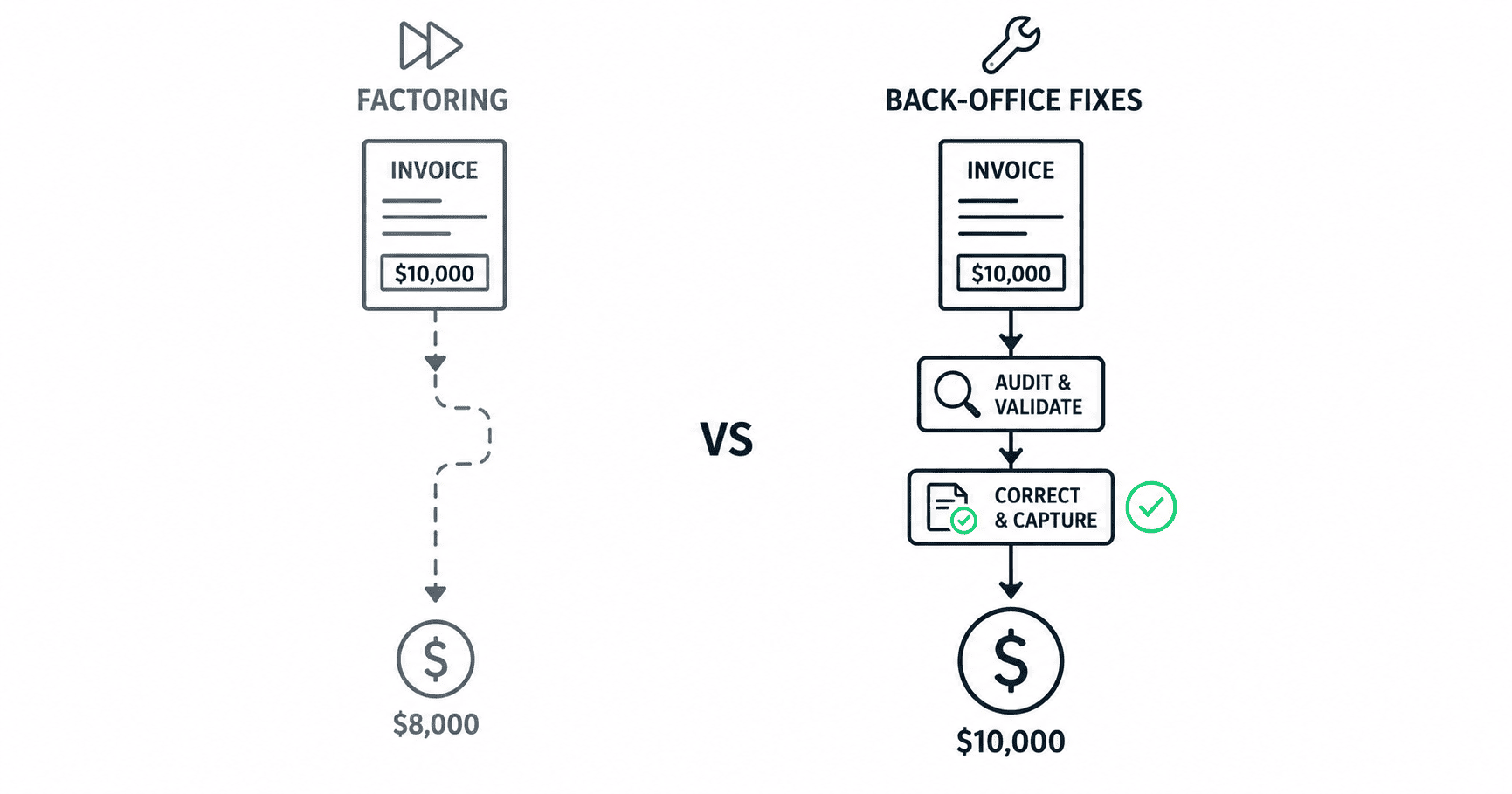
When cash gets tight, most freight companies reach for factoring. It works: you sell the invoice, the money lands tomorrow, payroll clears. But factoring treats a symptom. If invoices go out late, get disputed, or never capture the full charge in the first place, factoring just gives you faster access to less money. Fixing the billing operation attacks the cause.
These are two different tools that get compared as if they were substitutes. Here is what each one actually solves, what each costs, and how to decide which problem you have.
What does factoring actually solve?
Factoring solves a timing problem. You deliver a load, invoice the shipper or broker, and instead of waiting 30 to 60 days for payment, you sell the receivable to a factor and get most of the cash within a day. Fees commonly run 1-4% of invoice value depending on volume, recourse terms, and customer credit quality. For a carrier running tight on fuel and payroll, that trade is often worth it.
What factoring does not do: it does not make your invoices accurate, it does not capture the detention or lumper fees your paperwork missed, and it does not fix disputes. A factor advances you money against the invoice you created. If the invoice is wrong or incomplete, you factored the wrong number.
What does an outsourced billing operation solve?
An outsourced billing team fixes the mechanics that slow your cash down: POD retrieval within 24 hours instead of days, invoices out with complete documentation so they are accepted on the first pass, a pre-billing audit that catches missed accessorials before the invoice leaves, and structured accounts receivable (AR) follow-up so nothing ages quietly past 45 days.
The revenue impact is measurable on both ends. In our experience, companies without a structured pre-billing audit leave 2-5% of billable revenue uncaptured, and the average freight broker runs DSO between 45-65 days. Clean billing pushes both numbers in your favor: more of the money you earned gets invoiced, and it comes in sooner.
How do the costs compare?
Run the math on a $2 million monthly billing operation. Factoring at 2% costs $40,000 per month, every month, as long as you factor. That buys speed, not accuracy.
Now the billing side. At the 2-5% we plan around, that same operation has $40,000 to $100,000 per month in earned but unbilled revenue at risk. A billing operation that captures those charges and cuts DSO does not just pay for itself; it changes how much cash exists to accelerate. Run your own numbers in the DSO calculator to see what each day of improvement is worth.
| Factoring | Outsourced billing | |
|---|---|---|
| What it fixes | Timing: cash tomorrow instead of Net 30-45 | Mechanics: invoices right, complete, out same day |
| Cost on $2M/month | About $40,000/month at 2%, recurring | Engagement scope; offsets $40,000-$100,000/month of unbilled exposure |
| Effect on invoice quality | None; the factor buys whatever you wrote | The product itself |
| Effect on DSO | Masks it; the underlying number stays | Attacks it directly |
| When you stop | Cash gap reopens immediately | Improvements persist in the process |
| Customer relationship | Factor contacts your customers with the notice of assignment | Billing stays in your name |
Carriers weighing a factoring line against a broker quick pay program are running a different version of the same trade, and the quick pay vs factoring calculator puts an annualized cost on each option next to standard net terms. One legal detail worth knowing before you sign: the notice of assignment that redirects your customers’ payments to the factor operates under UCC 9-406, and unwinding it later requires the factor’s release. Billing done in your own name carries no such string.
When does factoring still make sense?
- You are a new carrier or brokerage without payment history, and customers pay on Net 45+ terms.
- You are growing faster than your working capital: every new customer means weeks of float you cannot cover.
- A single large customer stretched terms and you need a bridge, not a new operating model.
In those cases factor, but factor clean invoices. Accurate, complete billing lowers your dispute rate, which is also what a factor prices when they set your fee.
When is fixing the billing operation the better move?
- Your DSO sits above the 45-65 day benchmark because invoices go out late or get kicked back.
- You suspect missed accessorials: detention, layover, TONU, and lumper fees that never make the invoice.
- Factoring fees have become a permanent line item and you are effectively renting cash flow you could own.
- The billing desk is the bottleneck: volume grew and the paperwork did not keep up.
Many operations run both for a transition period: keep factoring for cash certainty while the billing operation cuts DSO, then reduce factoring volume as collections catch up. For the lever-by-lever version, see the seven levers to reduce DSO.
The one-year math, side by side
Take the same $2 million monthly billing operation through both doors. Factoring at 2% costs $480,000 over a year, buys immediate cash on every invoice, and changes nothing about what gets billed. The billing operation costs a fraction of that at scoped, managed-service pricing, recovers some share of the $40,000 to $100,000 per month in typically uncaptured charges, and pulls DSO down over two payment cycles, which releases working capital once rather than renting it monthly.
The comparison is unfair on purpose: they solve different problems. The year-one question is which problem you actually have. If customers pay reliably at 45 days and you simply cannot float that long, factoring is doing its job. If cash feels tight because invoices leave late, incomplete, or wrong, factoring is an expensive bandage on a process wound.
Frequently Asked Questions
They price differently, so compare annual totals. Factoring costs a percentage of every invoice you factor, commonly 1-4%, for as long as you factor. An outsourced billing operation is priced on volume and also recovers the 2-5% of billable revenue that typically goes uncaptured without a pre-billing audit. For operations with solid customer credit, fixing billing usually wins over a full year.
Yes, and it is a common transition setup. The billing team gets invoices out fast, complete, and audited, while factoring covers cash flow. Clean billing also raises the quality of the receivables the factor buys, which can improve your advance rate and reduce chargebacks. As DSO drops and working capital rebuilds, many companies reduce the share of invoices they factor.
Factors price risk. A book of clean, well-documented invoices with a low dispute rate is easier to advance against than one full of short-pays and chargebacks. Cleaner billing strengthens your negotiating position on rates and reserves.
Measure two numbers: your current DSO against the 45-65 day benchmark, and your accessorial capture rate. Those tell you how much cash is trapped in your own process. Start with POD turnaround and pre-billing audit, because they unblock everything downstream.
Want to see what a freight-specialized back office looks like on your loads? Request a demo. Or email us at info@getclearlane.com.