
From 72-Hour POD Turnaround to 18 Hours: A 3PL’s Process Transformation
Note: This case study uses anonymized data from a composite of freight operations. Company details have been generalized to protect confidentiality.
What Did the 3PL’s POD Process Look Like Before the Change?
A regional 3PL, roughly 2,000 to 2,500 loads per month and $35 to $40 million in annual revenue, operating primarily in dry van across a 12-state footprint, was running a billing cycle that felt slow but hadn’t been formally measured.
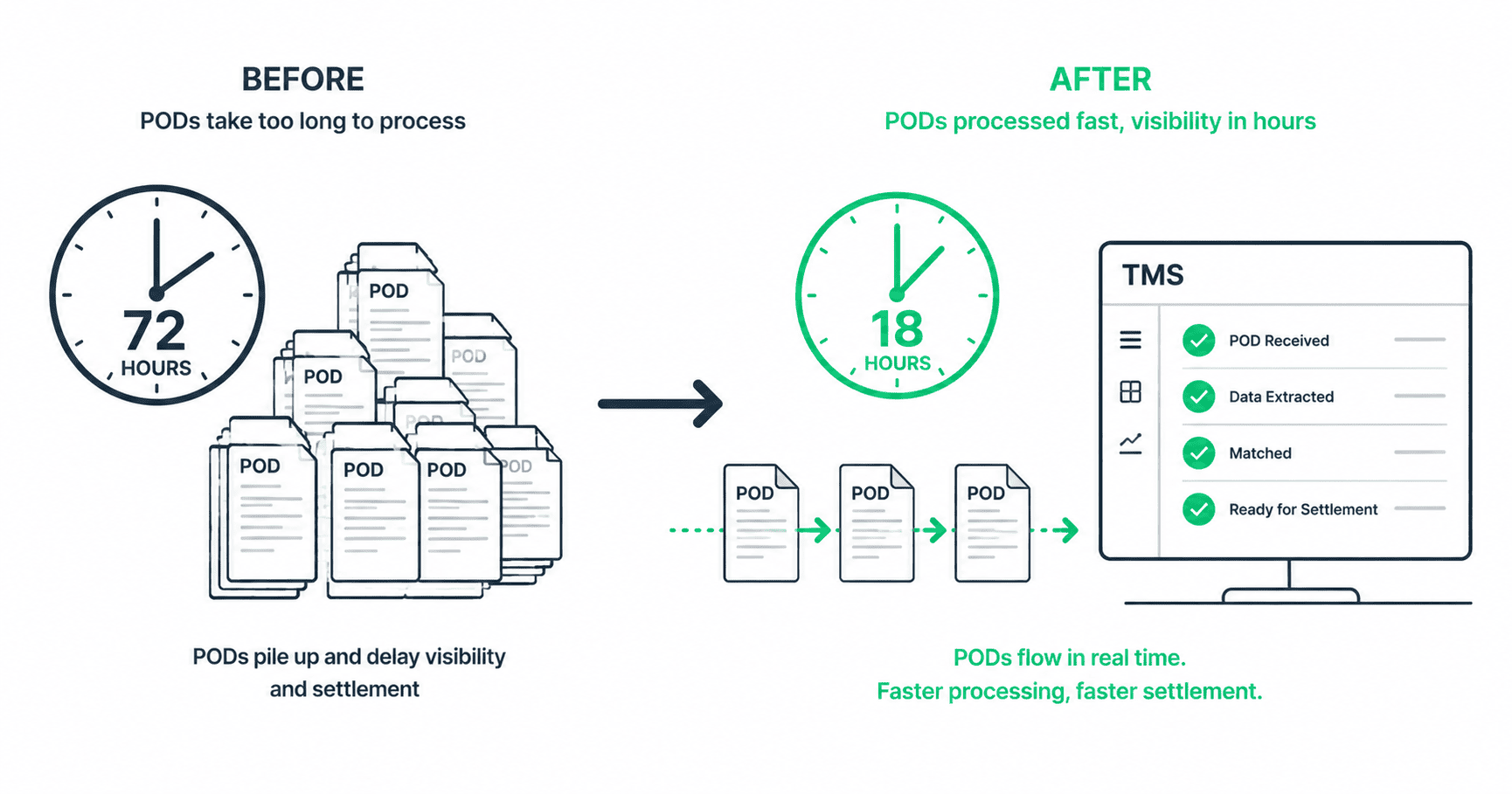
When the operations team finally measured it, the numbers were worse than expected. Average POD retrieval time from delivery confirmation was 72 hours. Some loads, particularly those with smaller carriers, owner-operators, or carriers who required phone calls rather than portal downloads, stretched past five days.
The 72-hour average meant that the billing team couldn’t start preparing invoices until three days after delivery on a typical load. Combined with the billing team’s own processing time (12 to 24 hours for routine invoices, longer for complex billing), the total delivery-to-invoice cycle was running four to five days.
At $38 million in annual revenue, roughly $3.17 million in monthly billings, each day of billing delay represented approximately $106,000 in receivables outstanding longer than necessary. A four-to-five-day billing cycle versus a two-day cycle meant roughly $200,000 to $300,000 in working capital perpetually tied up in the billing pipeline.
The 3PL’s DSO had crept from 44 days to 53 days over the preceding year. The POD delay was the single largest contributor, but it had been masked by other factors: a few slow-paying customers, a spike in billing disputes, and seasonal volume increases that the team attributed to normal fluctuation.
Why Was POD Retrieval Taking 72 Hours?
The root cause wasn’t a broken process. The 3PL had a documented POD retrieval procedure: check carrier portals daily, email carriers who hadn’t uploaded PODs within 48 hours, call carriers who hadn’t responded to the email. The procedure existed. The problem was capacity to execute it.
Two people were responsible for POD retrieval. Those same two people also handled shipper billing, some accounts receivable (AR) follow-up, and carrier compliance documentation. POD retrieval was one of four functions sharing the same bandwidth.
When the team was busy, which was most of the time, POD retrieval was the function that got triaged. Billing had deadlines (customer-specific submission windows, weekly invoicing requirements). AR had urgency (overdue invoices need immediate attention, customers calling about disputes). Compliance had specific requests (shipper audits, carrier onboarding documentation).
POD retrieval had none of these forcing functions. A late POD didn’t trigger a customer call. It didn’t have a submission deadline. It just sat, invisible to everyone except the billing team, who couldn’t invoice without it.
The result was predictable: easy PODs (carriers with automated portal uploads, carriers who emailed PODs proactively) were processed quickly. Difficult PODs (carriers who needed phone calls, carriers with slow portal uploads, owner-operators who didn’t respond to emails) accumulated. The “72-hour average” was actually a bimodal distribution: 58% of PODs arrived within 24 hours through automated processes, 74% had arrived within 48 hours, and the remaining quarter took three days or longer, some past five, because they required active follow-up that the team didn’t have time for.
What Process Changes Cut POD Turnaround to 18 Hours?
The 3PL separated POD retrieval into a dedicated function with defined capacity and a structured escalation cadence. The change was implemented over a two-week period.
The escalation cadence was built around four time-based triggers, starting at delivery confirmation:
Hour 0-4: Automated and portal check. Within four hours of delivery confirmation, the POD team checks the carrier’s document portal and the incoming email queue for the POD. For carriers with automated upload processes, the POD is typically available at this stage. The team downloads, verifies against the bill of lading (the carrier-issued receipt governed by 49 CFR Part 373) and the rate confirmation, and uploads to the TMS. For carriers without automated processes, the absence of a POD at hour four triggers the next step.
Hour 4-6: First outreach. An email or carrier portal message requesting the signed POD. The request includes the load number, delivery date, and a direct reply method. The tone is operational, not adversarial. The request goes out the same day as delivery, not the next morning, not when someone gets to it.
Hour 6-12: Follow-up. If no POD has been received by hour 6, a phone call goes to the carrier’s operations contact. The call references the email request. For carriers known to be slow responders (based on historical data), the phone call may happen simultaneously with the email rather than as a follow-up.
Hour 12-24: Escalation. If no POD at the 12-hour mark, a second call goes to the carrier’s dispatcher or owner. The conversation is direct: the load delivered, the documentation is needed, and there’s a billing timeline. Loads without a POD at 24 hours are flagged as exceptions and placed on a daily follow-up list.
The escalation cadence was the same for every load regardless of dollar value. No triage. No prioritization by invoice size. Every load started on the same timeline, and the only later adjustment was by carrier response history, never by load value.
The Results
The improvement was faster than expected. Within the first two weeks, the average POD turnaround dropped from 72 hours to 34 hours, primarily because the “easy” PODs that were already arriving quickly stayed quick, and the “difficult” PODs that had been sitting for days started getting attention on Day 1 instead of Day 3 or Day 4.
By day 30, average turnaround was 22 hours. By day 60, it stabilized at 18 hours.
The key metrics after 60 days:
Average POD turnaround: 18 hours (down from 72 hours). The improvement was 54 hours, more than two full days removed from the average retrieval time.
POD retrieval rate at 24 hours: 91% (up from 58%). Nine out of ten loads had a verified POD within 24 hours of delivery. The remaining 9% were on the exception list with active daily follow-up.
POD retrieval rate at 48 hours: 97% (up from 74%). Nearly every load had documentation within two days.
Exception rate (loads requiring more than two contacts): dropped from roughly 40% to 12%. The structured escalation cadence resolved most PODs within the first two contacts. The 12% exception rate represented a core group of carriers who consistently required additional follow-up, data that fed into the 3PL’s carrier performance evaluation.
How Did Faster POD Retrieval Affect Billing and DSO?
The POD improvement cascaded through the billing pipeline in ways that validated the investment.
Invoice cycle time compressed by about 2 to 2.5 days. With PODs arriving 54 hours sooner on average, the billing team could prepare and submit invoices about 54 hours sooner. The total delivery-to-invoice cycle dropped from four to five days to two to two-and-a-half days.
Billing dispute rate decreased. This was an unexpected benefit. When PODs were arriving late, the billing team was sometimes preparing invoices from partial documentation, sending the invoice with an initial POD scan and planning to follow up with the final version. Shippers rejected some of these invoices for incomplete documentation. With PODs arriving same-day, the billing team had complete documentation for every invoice from the start. Disputes related to missing or incomplete documentation dropped by roughly 40%.
DSO moved. The 3PL’s DSO dropped from 53 days to 46 days over the first 90 days, not solely from the POD improvement (the billing team also tightened their processing cadence), but the POD turnaround was the largest single contributor. The seven-day DSO reduction on $38 million in annual revenue represented approximately $730,000 in working capital freed up.
The billing team’s workload actually decreased. This was counterintuitive: faster PODs meant more invoices ready for processing each day. But the invoices were ready with complete documentation, which meant fewer exceptions, fewer follow-ups for missing documents, and less rework. The net effect was that the billing team processed more invoices in less total time because each invoice required less handling.
What Made It Work
Two factors made the difference.
Dedicated capacity was the primary factor. POD retrieval best practices are well understood: check portals, send requests, follow up, escalate. The 3PL’s original process had all of these steps documented. What it didn’t have was dedicated capacity to execute them. When POD retrieval became a dedicated function rather than a shared one, the process that had always existed on paper finally got executed consistently.
Carrier-level data drove escalation timing. Within the first two weeks, the POD team had data on which carriers responded to emails, which ones required phone calls, and which ones needed escalation to their owner or operations manager. By week three, the escalation timing was customized by carrier: fast responders got a simple email, slow responders got an immediate phone call, and chronic non-responders went to direct escalation on Day 1. This data-driven approach reduced the total number of contacts needed per POD because the first contact was the right contact for that carrier.
The Takeaway
A 54-hour improvement in average POD turnaround, from 72 hours to 18 hours, compressed the billing cycle by about two to two-and-a-half days, reduced documentation-related disputes, and contributed to a seven-day DSO reduction worth $730,000 in freed working capital.
The operational change was straightforward: dedicated capacity for POD retrieval with a structured escalation cadence. The same approach applies to any freight company where POD retrieval is bundled with other back-office functions and turnaround times have drifted above 24 hours. For a brokerage example, see how a broker reduced DSO from 58 to 41 days.
ClearLane provides dedicated POD retrieval as part of the full post-dispatch pipeline, targeting retrieval within 24 hours of delivery confirmation with verification and TMS upload included.
Frequently Asked Questions
By separating POD retrieval into a dedicated function with a structured escalation cadence: portal check within 4 hours, first outreach from hour 4, a follow-up call from hour 6, escalation at hour 12 and exception flagging at hour 24. No triage by invoice size: every load started on the same timeline, adjusted only by carrier response history.
DSO dropped from 53 to 46 days, a 7-day improvement representing approximately $730,000 in freed working capital on $38 million in annual revenue.
The 3PL had a documented POD procedure, but the two people responsible also handled billing, AR, and compliance. PODs got chased when there was time, which meant high-value loads first and everything else when they got to it.
In this case, average turnaround dropped from 72 hours to 34 hours within the first two weeks, and stabilized at 18 hours by day 60.
Want to see what dedicated POD retrieval would look like for your operation? Talk to our team to walk through it. Or email us at info@getclearlane.com.