
How a Mid-Size Broker Reduced DSO from 58 to 41 Days
Note: This case study uses anonymized data from a composite of freight brokerage operations. Company details have been generalized to protect confidentiality.
What Did the Broker’s Back-Office Look Like Before the Changes?
A mid-size freight brokerage (roughly 2,500 to 3,000 loads per month and $40 to $45 million in annual revenue, running a mix of dry van and reefer across regional and long-haul lanes) was experiencing a gradual increase in DSO that had reached 58 days.
The 58-day number hadn’t appeared overnight. It had crept up from 45 days over the course of roughly 18 months, tracking with the company’s growth from under 2,000 to nearly 3,000 loads per month. Revenue was up 55%. The back-office team had added one person during that period (going from three to four), but the workload had more than doubled when accounting for increased load complexity, more carrier relationships, and additional shipper billing requirements.
The DSO trend wasn’t caused by a single problem. It was the result of several operational gaps compounding:
POD retrieval averaged 62 hours from delivery confirmation. Some loads ran past five days. The billing team couldn’t prepare invoices until the POD was in hand, so every hour of POD delay added directly to the billing cycle.
Invoice error rates were running at approximately 7.2%, meaning roughly 200 invoices per month went out with errors that triggered disputes. Wrong PO numbers, missing documentation, incorrect rates, and unbilled accessorials were the primary causes. Each disputed invoice added 10-14 days to the payment cycle on that load.
Accounts receivable (AR) follow-up was done in weekly batches. Someone would pull the aging report on Friday, make calls and send emails on Monday and Tuesday, and move on to other work. Overdue invoices that came in on Wednesday sat until the following Monday before getting attention.
Missed accessorial revenue was estimated at 3 to 4% of billings: detention, layover, and fuel surcharge differences that weren’t making it onto shipper invoices. This wasn’t a DSO issue directly, but it was margin loss that compounded the cash flow pressure.
What Three Operational Changes Reduced DSO by 17 Days?
The brokerage restructured its post-dispatch operations by dedicating specific capacity to each function rather than having a shared team handle everything. The changes were implemented over a 60-day period.
POD retrieval got dedicated capacity with a defined escalation cadence. Instead of chasing PODs when time allowed, the process followed a structured timeline: portal check within four hours of delivery, first outreach by hour six if no POD, follow-up call by hour 12, escalation at hour 24. Loads without a POD at 24 hours were flagged as exceptions and reported daily.
The result: average POD turnaround dropped from 62 hours to under 20 hours within the first 30 days. The percentage of loads with a verified POD within 24 hours went from roughly 55% to 88%.
The billing cycle improvement was nearly immediate. With PODs arriving 40 hours sooner on average, invoices could be prepared and submitted 40 hours sooner. That time reduction flowed directly into DSO.
A pre-billing audit was added between invoice preparation and submission. Every invoice was reviewed against the shipper rate agreement, dispatch notes, and carrier documentation before going to the shipper. The audit checked for PO accuracy, rate correctness, accessorial completeness, documentation attachment, and billing entity accuracy.
The impact on dispute rates was significant. Within 60 days, the invoice dispute rate dropped from 7.2% to under 2%. That meant roughly 145 fewer disputed invoices per month. Those invoices previously would have added 10 to 14 days each to the payment cycle. The pre-billing audit also captured missed accessorial charges that had been falling through the dispatch-to-billing handoff.
AR follow-up moved from weekly batch processing to a daily structured cadence. Invoices were monitored against defined triggers: a courtesy confirmation at day 15 (verifying the invoice was received and in the shipper’s payment system), a follow-up at day 30 for any invoice not showing movement toward payment, and escalation at day 45 to a senior contact at the shipper. Each step had a template and a defined action, not a general “check on overdue invoices” task.
The daily cadence meant that overdue invoices got attention within 24 hours of triggering a threshold, not at the next weekly batch. The difference was measurable: average days past due on overdue invoices dropped from 22 days to 11 days.
What Were the Measurable Results After Six Months?
Over six months, the combined effect of these three changes produced the following results:
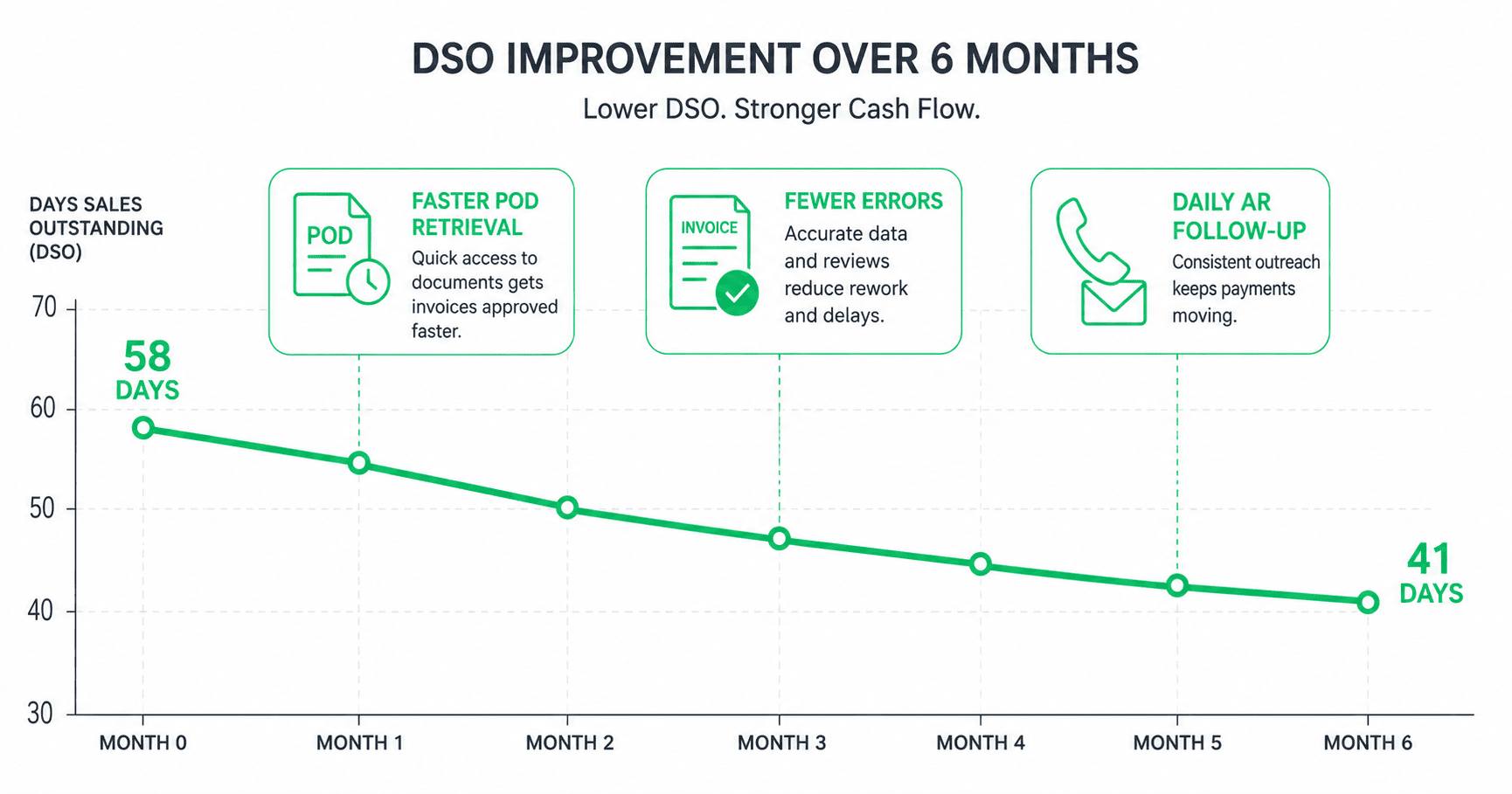
DSO dropped from 58 days to 41 days. The 17-day reduction represented roughly $2 million in working capital that was previously locked in the receivables pipeline.
Invoice dispute rate dropped from 7.2% to 1.8%. The reduction in disputes was the single largest contributor to the DSO improvement, because disputed invoices were the longest-duration delays in the payment cycle.
POD turnaround dropped from 62 hours to under 20 hours. This improvement compressed the entire billing timeline by roughly 1.5 to 2 days on every load.
Accessorial capture rate improved from an estimated 96-97% to approximately 99%. The pre-billing audit caught detention, layover, and fuel surcharge differences that had previously been missed. The recovered revenue was incremental to the DSO improvement: additional margin on loads that were already being billed.
AR aging profile improved across all buckets. The 60-day-plus bucket, which had been running at roughly 12% of outstanding receivables, dropped to under 4%.
Why Did These Changes Produce Results When Past Efforts Didn’t?
Three factors made the difference between these changes producing results and being another operations improvement initiative that fades after 90 days.
Dedicated capacity for each function. The most important change wasn’t any single process improvement. It was separating the functions so that each one got focused attention. POD retrieval, pre-billing audit, and AR follow-up had all been handled by the same team. When they were separated into dedicated workstreams, each function improved because the people doing the work weren’t constantly switching between priorities.
Measurement from day one. Every metric (POD turnaround, dispute rate, AR aging, DSO) was tracked weekly from the start. The team could see the improvements happening in real time, which created momentum. When POD turnaround dropped from 62 hours to 30 hours in the first two weeks, it validated the approach and built confidence in the remaining changes.
Process discipline over heroic effort. The previous model relied on a small team working hard and making judgment calls about what to prioritize. The new model was process-driven: defined cadences, templates, escalation triggers, and exception reporting. The work didn’t require more effort. It required consistent execution of a defined process. That consistency was what the shared-team model couldn’t provide.
The Takeaway
A 17-day DSO reduction at a $40-plus million brokerage isn’t the result of a single initiative. It’s the result of compressing time out of every stage of the post-dispatch pipeline simultaneously: faster POD retrieval, cleaner invoices, and more structured collections.
The operational changes are straightforward. Every operations manager at a freight brokerage knows that faster PODs, fewer billing errors, and more consistent AR follow-up will improve DSO. The gap is always capacity: the team responsible for these functions doesn’t have enough bandwidth to execute all of them consistently.
Closing that gap (through dedicated hires, outsourced capacity, or both) is what turns the operational knowledge into financial results.
ClearLane provides dedicated teams for the full post-dispatch pipeline: POD retrieval, carrier invoice verification, pre-billing audit, shipper billing, carrier compliance, AR management, and bookkeeping. That is the capacity to execute these functions consistently, on every load, every day.
Frequently Asked Questions
Three changes: POD retrieval turnaround went from 62 hours to under 20, a pre-billing audit dropped the invoice dispute rate from 7.2% to 1.8%, and AR follow-up shifted from weekly batch processing to a daily structured cadence.
At roughly $40 to $45 million in annual revenue, a 17-day DSO reduction freed approximately $2 million in working capital that was previously locked in the receivables pipeline.
The dispute rate reduction was the single largest contributor. Going from 7.2% to 1.8% eliminated roughly 145 disputed invoices per month, each of which had been adding 10-14 days to the payment cycle.
Measurable DSO improvement typically appears within 60 to 90 days of implementing changes to POD retrieval, billing accuracy, and AR collections cadence.
Want to see what a similar improvement could look like for your operation? Talk to our team to walk through your current DSO drivers. You can also calculate your DSO benchmark first. Or email us at info@getclearlane.com.