
What a Fractional CFO Does for a Trucking Company (and When You Need One)
Somewhere past a few million in revenue, every trucking company and freight brokerage hits the same wall: the finances have outgrown the owner’s spare evenings, but the business cannot justify a $300,000 finance executive. The term that keeps coming up in that gap is the fractional CFO, a senior finance leader who works for several companies at once, a few days a month each.
The term gets used loosely, so it is worth being precise about what a fractional CFO actually does, what one costs, when a freight operation genuinely needs one, and when the problem being described is actually something else.
What does a fractional CFO actually do?
A fractional CFO does the same job a full-time CFO does, on a part-time cadence. The core of it:
- Cash flow forecasting: knowing what the bank account looks like eight weeks out, not just today
- Margin analysis: which customers, lanes, and services actually make money once every cost lands
- Financing: choosing between a bank line, factoring, and equipment finance, and negotiating the terms
- Lender and investor relationships: being the credible finance voice when capital is on the table
- Big-decision support: pricing changes, large customer negotiations, acquisitions, and exits
The typical engagement runs two to four days a month. The value is judgment: someone who has seen a hundred versions of your situation and knows which numbers matter this quarter.
What the monthly cadence looks like
A well-run fractional engagement has a rhythm, and knowing it helps you judge whether you are getting the real thing:
- A monthly close review: the CFO reads the package, questions the surprises, and adjusts the forecast
- A rolling 13-week cash forecast, updated with actuals, so financing needs surface early instead of urgently
- A short KPI pack the owner actually reads: margin by lane or customer, DSO, carrier cost trend, and cash runway
- A quarterly conversation with the lender or the board, led by someone who speaks their language
- Ad hoc deal work when a transaction, dispute, or renegotiation puts real money in motion
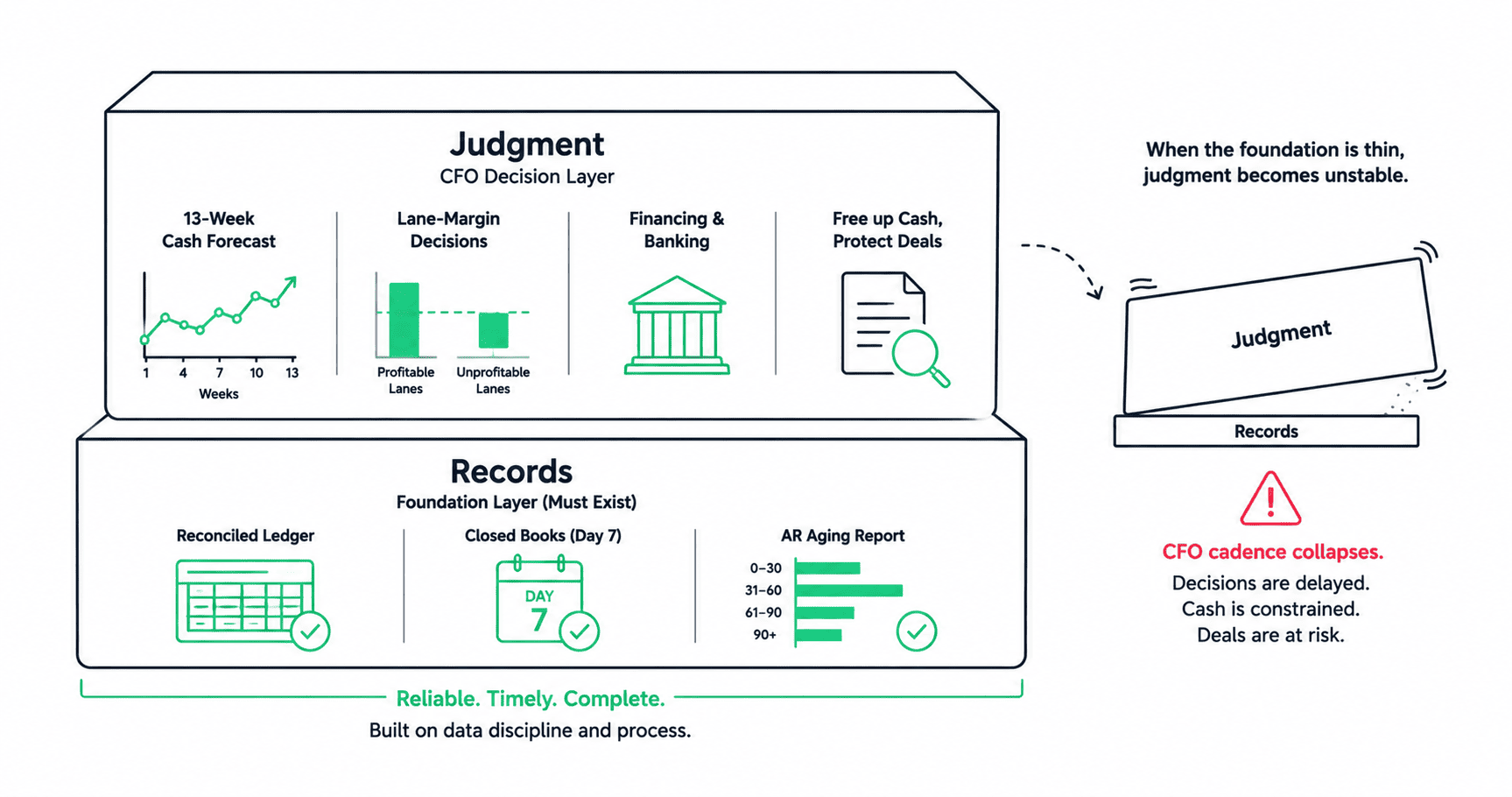
Notice what every item assumes: reports that already exist, close on time, and can be trusted. The cadence collapses without them.
What does a fractional CFO do differently in freight?
Freight finance has its own physics, and a generalist CFO spends their first six months learning it. Margin lives at the load and lane level, not the account level, so profitability analysis has to reach into the TMS. Cash timing is dominated by the gap between paying carriers fast and collecting from shippers slow, which makes the factoring-versus-collections decision a recurring strategic question rather than a one-time setup choice. Fuel, insurance, and equipment costs move independently of revenue. And in a consolidating market, an owner is never more than one phone call away from needing deal-ready financials.
A freight-literate fractional CFO earns their fee on exactly these points: reading a lane profitability report correctly, knowing what a factoring facility really costs annualized, and preparing the numbers a buyer or lender will actually test.
What does a fractional CFO cost?
The market structure is consistent even where the numbers vary. Full-time CFO compensation commonly lands between $200,000 and $300,000 a year once bonus and benefits are counted, which is what makes the fractional model attractive: engagements are typically priced as monthly retainers or day rates, scaling with the cadence the operation needs rather than the transaction count. For a mid-size freight operation, that is senior finance leadership at roughly a tenth of the full-time cost.
The return math is lumpy but real. A renegotiated credit facility, a factoring agreement replaced with a cheaper line, or one mispriced lane caught early can each cover a year of retainer on their own. That is why the hire works best when a specific decision is on the table, and worst when it is bought as general reassurance.
The number to watch is not the retainer; it is the hours inside it. A fractional CFO who spends their limited days assembling reports instead of reading them is an expensive report builder. Which raises the real question.
When do you actually need one?
The clean signals:
- A financing event is coming: a larger credit line, equipment refinancing, or replacing an expensive factoring facility
- A transaction is possible: buying a competitor, selling the company, or bringing in a partner
- Margin is drifting and nobody can say why: revenue is up, the bank account is not, and the explanations are guesses
- The owner has become the finance department: every pricing, credit, and capital decision routes through one person who also runs the business
If two or more of these are true, a fractional CFO is usually worth the retainer. If none are true yet, what most owners need first is visibility, and that is a different purchase.
Five questions to ask before you hire one
- Have you run finance for a freight operation before? Lane-level margin, factoring mechanics, and carrier settlement are not transferable intuitions from retail or SaaS.
- Walk me through how you would evaluate our factoring facility. The answer should include the annualized cost, the recourse terms, and what collections discipline would have to look like to replace it.
- What does your first 90 days look like? Listen for whether it starts with fixing the reporting, because if it does, you may be buying the wrong layer first.
- Who builds the packages you will rely on? If the answer is “I do,” their retainer is going into assembly. If the answer is “your team,” ask whether your team can.
- What happens when your other clients have a crisis in the same week we do? Fractional means shared, and the honest answer tells you a lot.
None of these have a single right answer. They exist to surface whether you are buying judgment, production, or both, because the price of confusing them is paying executive rates for spreadsheet work.
When the job is really reporting work
Here is the pattern worth knowing before hiring anyone. A large share of what owners describe when they say “I need a CFO” is not judgment at all: a monthly package that actually arrives, lender reporting that goes out on time, entities that roll up into one combined statement, receivables and cash positions that are current instead of three weeks stale. That is production work, not judgment work.
Production work does not need executive hours; it needs a desk that closes the books, builds the packages, and delivers them on a schedule. That is what ClearLane runs as independent owner reporting: the owner, board, and lender packages, multi-entity combined statements, and deal-ready financials a CFO would otherwise spend their retainer assembling, delivered weekly, monthly, or quarterly, per your SOP. Underneath it, outsourced bookkeeping keeps the daily records the packages are built from.
The honest sequencing for most freight operations: get the reporting layer producing first. Then decide whether you still need the judgment layer, and if you do, hire it knowing the new CFO starts with a working package on day one instead of a shoebox. And if you want the judgment layer from the same provider, ClearLane offers fractional CFO services for trucking and logistics directly, in a limited number of engagements.
How the layers fit together
Freight finance works as a stack, and confusion about the layers is where money gets wasted:
| Layer | What it produces | Who does it |
|---|---|---|
| Recording | Categorized transactions, reconciled accounts, month-end close | A bookkeeper, in-house or outsourced |
| Reporting | Owner and board packages, lender reporting, combined statements | A reporting desk like ClearLane’s |
| Judgment | Pricing, financing, and deal decisions built on those reports | The owner, or a fractional CFO |
| Compliance | Tax filings and audited statements | Your CPA, always |
Each layer assumes the one below it works. A fractional CFO on top of broken reporting produces expensive frustration; clean reporting with no judgment layer produces packages nobody acts on. Most operations under $50 million get the best return fixing the middle two layers first, and the working-capital stakes are visible in the freight DSO and AR benchmarks: the difference between structured and unstructured finance operations shows up as weeks of cash. The staffing math behind doing all of this in-house is covered in the true cost of in-house back-office staffing, and where the CPA fits is in bookkeeping vs your CPA.
Usually nothing. Both describe a senior finance leader working part time across several companies. Fractional has become the more common term; outsourced CFO sometimes implies a firm rather than an individual. What matters more than the label is freight literacy and whether the engagement includes building reports or only reading them.
Below roughly $10 million in revenue, rarely as a standing role. What small operations need is the layer underneath: clean books, a reliable monthly package, and current receivables reporting. A fractional CFO becomes worth the retainer when a financing event, a transaction, or unexplained margin drift puts real money on the table, and even then the engagement works better when the reporting already exists.
Yes. The reporting a CFO relies on, owner and board packages, lender reporting, multi-entity combined statements, and deal-ready financials, is production work that a dedicated reporting desk can run on a schedule at a scoped fee. Judgment stays with you or a fractional CFO you hire later; the desk makes sure whoever holds it works from numbers that are current and complete.
Wondering which layer your operation is missing? Request a demo and we will walk through what your reporting could look like. Or email us at info@getclearlane.com.