
What a Freight Broker Back Office Actually Does
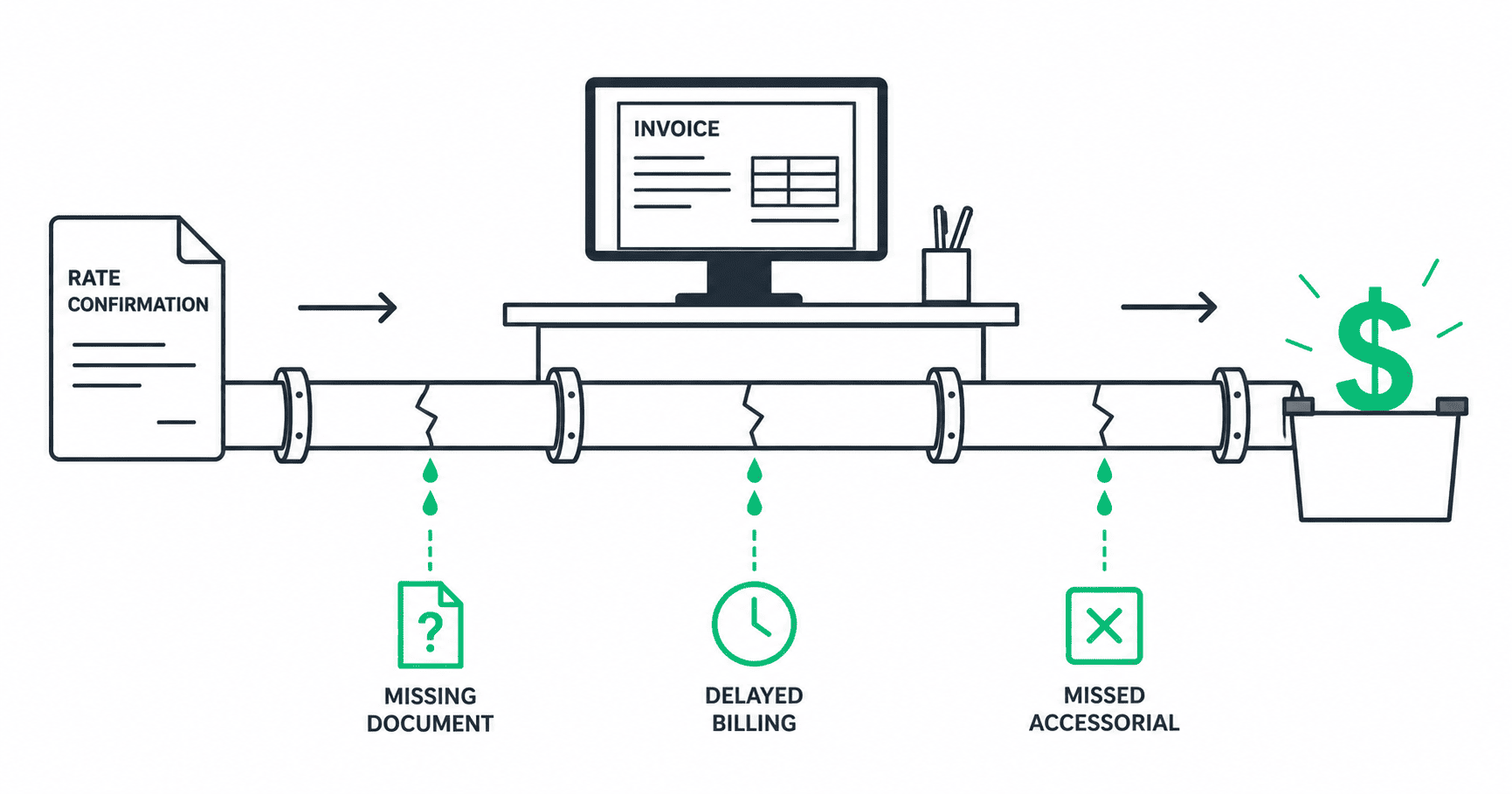
In a freight brokerage, the back office is everything that happens after the load is covered. Sales and dispatch book the freight and keep trucks moving. The back office turns that activity into clean invoices, collected cash, and correctly paid carriers. It is the quiet half of the business, and it is where a real share of margin is either protected or lost.
Plenty of brokers treat it as admin, the paperwork you handle once the real work is done. That framing is exactly how the leaks start. Here is a plain breakdown of what a freight broker back office actually handles, function by function, and the specific points where revenue and cash slip out.
The functions a back office covers
Before getting into where things break, it helps to name the parts. A freight broker back office is usually responsible for retrieving proof of delivery, building and sending shipper invoices, auditing and paying carrier invoices, capturing accessorial charges, managing accounts receivable (AR) and collections, and keeping the books reconciled. Each one is a link in the same chain that runs from a delivered load to money in the account. When any link is slow or sloppy, the whole chain slows with it.
The billing cycle: from delivery to invoice
The first job is getting paid for the load you just moved. That starts with proof of delivery. Many customers will not pay until a signed POD is attached to the invoice, so POD retrieval is the gate the whole billing cycle waits on. When a POD takes two or three days to land, the invoice waits two or three days, and so does the cash.
Once the document is in, the back office builds the shipper invoice: the correct rate, the reference and PO numbers the customer expects, the accessorials that apply, and the supporting paperwork attached. A clean invoice gets processed. An invoice with a wrong PO or a missing receipt gets set aside, and usually nobody calls to tell you. It just sits in a queue on the customer side until someone follows up.
Think about the math on a single load. If the POD lands the day of delivery and a clean invoice goes out the next morning, you have lost no time. If the POD takes three days and the invoice sits another day for review, you have added three days to that load before the customer has even received the bill. Let that become the norm across every load in a month and your average collection time moves out by those same three days, without anything actually going wrong. That is the cost of a slow cycle: not errors, just delay.
Auditing what you pay carriers
The other side of the ledger is accounts payable. Every carrier invoice should be checked against the rate confirmation and the supporting documents before it gets paid. Carrier invoice audit catches duplicate invoices, rate mismatches, and accessorials that were never agreed to. Paid blind, those add up quietly, because nobody disputes a carrier overpayment that nobody noticed.
A carrier invoice that comes in a hundred dollars over the rate confirmation is easy to approve without a second look. Do that on a handful of loads a week and the leak is real by the end of the quarter. The audit is the only thing standing between the rate you agreed to and the rate you actually pay, and on thin per-load margins it protects money that would otherwise walk straight out the door.
Collecting what you are owed
An invoice is not money until it is collected. Accounts receivable is the follow-up engine: tracking what is outstanding, working the aging buckets, and chasing balances before they drift past terms. Good AR is a cadence, not a scramble at month end. It means knowing which invoices are approaching their due date, which customers reliably pay late, and who to call this week before a balance ages another 30 days.
The clearest measure of how well this is working is Days Sales Outstanding, the average gap between invoicing a load and collecting on it. When follow-up is inconsistent, invoices slide into the 60 and 90 day buckets and the cash a brokerage needs to pay its own carriers gets tighter. For the specific levers that pull DSO down, see our breakdown of how to reduce DSO.
Where the money leaks
Most back-office leakage is not dramatic. It is a series of small, repeatable misses, and they tend to happen in the same four places.
The first is unbilled accessorials. Detention, layover, and other accessorial charges go uncaptured because the driver notes never reached billing in time. You can see exactly how that gap forms in our piece on capturing detention charges. The second is slow POD retrieval, which pushes invoices late and adds days to every affected load. The third is overpaid carrier invoices that were never audited against the rate confirmation. The fourth is aging receivables that nobody is actively working. Each one is small on a single load. Together, across a month of freight, they are the difference between the margin you quoted and the margin you actually keep.
Why it gets harder as you grow
At low volume, one person can hold all of this in their head. As load count climbs, the paperwork scales faster than attention does. Dispatch wins more freight, billing falls a day behind, then two. The work does not stop being important. It just stops being possible to do well in the cracks between everything else. That is usually the point where a growing brokerage leaks the most, right when the sales effort is finally paying off and the back office cannot keep pace.
The tell is often a billing person who is always busy but always behind, invoices going out later each week, and a DSO number that keeps creeping up. For more on spotting that, see the signs your billing team has become the bottleneck.
In-house, outsourced, or a mix
There is no single right structure. An in-house team gives direct control but carries fixed salary, benefits, management time, and turnover risk. Outsourcing adds trained capacity that scales with volume and lets you start with the one workflow that hurts most, whether that is POD chase, carrier invoice audit, or AR. Many brokers run a hybrid, keeping some functions inside and handing off the rest.
The honest comparison is between the fully loaded cost of doing it in-house and the cost of having it done reliably by a team whose only job is the back office. The point is not which model you pick. It is that the back office is real operational work with a direct line to your margin and your cash position. Treating it as an afterthought is exactly how the leaks start.
Frequently Asked Questions
It is the group of functions that handle everything after a load is covered: POD retrieval, shipper billing, carrier invoice audit and payment, accessorial capture, accounts receivable and collections, and bookkeeping. In short, it is the work that turns a delivered load into collected cash.
Chasing and filing PODs, building and sending accurate shipper invoices, auditing carrier invoices against rate confirmations before paying them, capturing detention and other accessorials, following up on outstanding receivables, and reconciling the books. The exact mix varies by brokerage, but those are the core jobs.
Both work. In-house gives direct control but carries fixed overhead and turnover risk. Outsourcing adds capacity that scales with load count and lets you hand off the workflow that hurts most first. Many brokers run a hybrid. The right answer depends on your volume, your margins, and how far behind billing currently runs.
It is usually priced by volume and scales with load count, so the cost tracks the work rather than a fixed salary. For most brokers it comes in below the fully loaded cost of an equivalent in-house hire once you count benefits, management, and turnover.
It varies by customer base and payment terms, but many brokers operate with DSO somewhere in the 45 to 65 day range, and the number climbs when billing is slow or follow-up is inconsistent. The more useful exercise is to measure your own DSO and watch the trend. You can estimate the working-capital impact with our DSO calculator.
Bookkeeping records and reconciles transactions after they happen. The back office does the operational work that produces those transactions in the first place: getting the invoice out, auditing the carrier bill, capturing the accessorial, collecting the payment. Bookkeeping keeps the record accurate. The back office protects the revenue and the cash.
Tighten the back office before it costs you
If billing is running a step behind your sales team, the back office is the place to look first. ClearLane runs the post-dispatch back office for freight brokers so the work that turns a delivered load into collected cash actually gets done, on time and audited. Talk to our team to see how it would fit your operation. Or email us at info@getclearlane.com.