
In-House vs Outsourced AR Collections: What Works Better for Freight Companies
Why Is AR Collections More Relationship-Sensitive Than Other Back-Office Functions?
This is the fourth post in the in-house vs outsourced comparison series, covering POD retrieval, carrier compliance, bookkeeping, and now accounts receivable (AR) collections. Of the four, AR is the most relationship-sensitive and the one where the in-house vs outsourced decision requires the most nuance.
POD retrieval is process work: check portal, send request, follow up, verify, upload. The workflow is the same on every load regardless of the customer. Carrier compliance is verification work: check authority, insurance, safety data. The workflow is the same regardless of the carrier relationship.
Accounts receivable collections involves direct communication with customers about money. The person making the call or sending the email is representing the brokerage in a financial conversation with a shipper the brokerage wants to retain. Tone, timing, and context all matter in ways they don’t for POD chasing or compliance monitoring.
This relationship sensitivity is the primary reason freight companies hesitate to outsource AR, and it’s a legitimate concern worth understanding clearly, not dismissing.
What Are the Advantages of In-House Accounts Receivable Collections for Freight?
At most freight brokerages, AR collections is handled by the same team that does billing, and sometimes POD retrieval and compliance as well. The collections function typically operates on a weekly batch process: someone pulls the aging report, reviews overdue invoices, makes calls, sends emails, and moves on.
The in-house advantages for AR are specific and real.
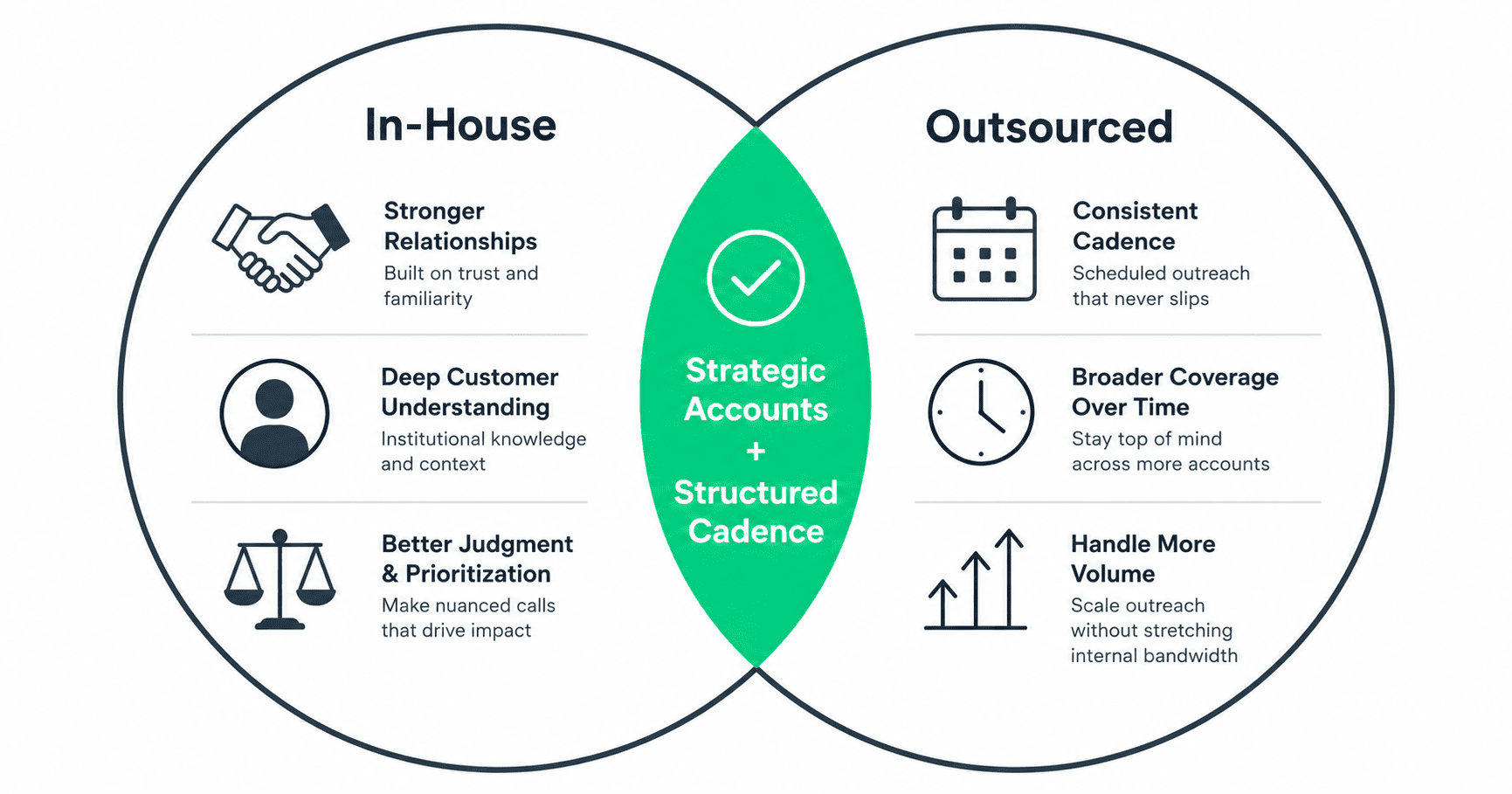
Customer knowledge runs deep. The in-house person knows the shippers. They know that Customer A always pays on day 35 and it’s not worth calling before then. They know that Customer B’s accounts payable (AP) team is responsive by email but doesn’t answer phone calls. They know that Customer C had a recent system migration that’s causing payment delays, and the right contact is the logistics coordinator, not the AP clerk. This institutional knowledge makes each collection interaction more effective: the right message, to the right person, at the right time.
Relationship context informs judgment. When a customer billing $50,000 a year has a $3,200 invoice that’s 45 days old, the in-house person weighs the collection urgency against the relationship value. They may choose a softer approach for a strategic account and a firmer approach for a transactional one. That judgment requires understanding the customer’s importance to the brokerage, which is context that’s hard to transfer to an external team.
Escalation is immediate. When an in-house collections issue needs to go up to the account manager or the brokerage owner, the escalation happens through internal relationships. The account manager is down the hall or on Slack. The context transfer is immediate. There’s no communication gap between the collections function and the relationship management function.
The in-house challenges are the same ones that affect every shared back-office function.
Consistency suffers when collections is a part-time responsibility. The daily cadence that drives DSO improvement (Day 15 confirmation, Day 30 follow-up, Day 45 escalation) requires dedicated daily attention. When the person doing collections is also doing billing and POD retrieval, the collections cadence runs when there’s time. That inconsistency is what lets invoices drift into the 60-day and 90-day aging buckets.
Coverage gaps create collection delays. When the collections person is on vacation or out sick, nobody follows up on overdue invoices for a week. Invoices that would have been resolved with a timely call sit and age.
Volume creates triage. At 3,000 loads per month, the AR portfolio includes hundreds of invoices at various stages of the payment cycle. The collections person prioritizes the biggest balances and the most overdue accounts. Smaller invoices and moderately late accounts (the long tail) don’t get attention until they’re seriously past due. That long tail is where preventable DSO inflation lives.
What Are the Advantages of Outsourced Accounts Receivable Collections for Freight?
An outsourced AR team provides dedicated capacity for the collections function, running a structured cadence on every invoice, every day, without competing priorities.
The advantages center on consistency and coverage.
Every invoice gets the same cadence. The Day 15 confirmation contact happens on Day 15, not on the next Monday batch, not when someone gets around to it. The Day 30 follow-up happens on Day 30. The Day 45 escalation happens on Day 45. No triage, no long tail of neglected invoices. The structured cadence that drives DSO improvement runs with perfect consistency because the team has no competing priorities.
Coverage is built in. No vacation-driven gaps, no sick-day delays. The collections cadence runs every business day regardless of individual team member availability.
Volume is absorbed without triage. Whether the AR portfolio has 500 active invoices or 2,000, the outsourced team processes the full volume. Smaller invoices get the same follow-up cadence as larger ones, which catches the submission errors, documentation gaps, and payment system issues that cause small invoices to age unnecessarily.
The economics follow the familiar pattern: outsourced collections come in below the fully loaded cost of equivalent in-house capacity, because the dedicated team achieves higher utilization on the collections function than a shared in-house team can. BLS wage data for bill and account collectors supplies the base salary layer of that in-house cost.
The outsourced challenges for AR are specific to the relationship-sensitive nature of the work.
Customer context takes time to develop. The outsourced team doesn’t know your customers on day one. They learn through the data, through the interactions, and through the notes in the system, but the institutional knowledge that an in-house person has accumulated over months or years of working the same accounts takes time to build.
Tone and approach need to be defined. Different brokerages have different collection philosophies: some are firm and systematic, some are relationship-first and gentle. The outsourced team needs clear guidance on tone, messaging, and escalation thresholds. This is a setup investment that pays off over time but requires upfront definition.
Sensitive accounts need special handling. Key accounts, strategic customers, and accounts with known relationship complexity shouldn’t be managed by an external team without in-house involvement. The outsourced team may not know that a particular customer is in a contract renewal discussion, or that a billing dispute on one lane is connected to a pricing negotiation on another.
What AR Collections Model Works Best for Growing Freight Companies?
The model that works for most growing freight companies is a split: outsourced execution on routine collections with in-house ownership of strategic accounts and escalation decisions.
The outsourced team runs the structured cadence on the full AR portfolio. Every invoice gets the Day 15, 30, 45, and 60 treatment. The routine work (confirmation contacts, standard follow-ups, documentation requests, payment timing inquiries) is handled by the dedicated team with consistent execution.
The in-house relationship manager receives reports on their key accounts and gets involved at defined escalation points. This might be: any invoice past 45 days on a top-20 customer, any dispute that involves a contract term interpretation, or any situation where the shipper’s response indicates a relationship issue rather than a payment process issue.
The split is defined by account tier and escalation trigger, not by function. The outsourced team does the collections work on all accounts. The in-house person provides judgment and relationship management on the accounts that need it.
This model gives the brokerage the consistency and coverage that drives DSO improvement (outsourced execution) combined with the relationship intelligence and judgment that protects key accounts (in-house oversight).
Defining the Split
Setting up the split requires defining three things.
Account tiers. Which accounts require in-house involvement at the first sign of a collection issue, and which accounts can be managed through the standard outsourced cadence? Most brokerages use revenue contribution as the primary criterion: the top 10-20 accounts get in-house oversight and the rest follow the standard process. Accounts with known relationship complexity or active contract negotiations may also be flagged for in-house involvement regardless of size.
Escalation triggers. At what point does an outsourced collection interaction escalate to in-house? Common triggers: any account past 45 days (for tiered accounts), any response from a shipper that indicates a dispute or relationship concern, any situation where the shipper requests to speak with “their” account representative. The triggers should be defined in advance, not decided case-by-case.
Communication protocol. How does the outsourced team communicate with the in-house relationship manager about key accounts? Daily reports, real-time flags for escalation triggers, weekly review calls? The protocol should be lightweight enough to be sustainable but thorough enough to ensure the in-house person has visibility into their key accounts’ AR status.
Measuring the Model
Whether accounts receivable is handled in-house, outsourced, or split, the metrics are the same:
DSO trend. The most important macro metric. Track monthly. A declining trend means the collections process is working. A flat or increasing trend means something in the cadence, capacity, or customer mix needs attention.
Days past due on overdue invoices. The average number of days an overdue invoice remains unpaid after the due date. This measures the effectiveness of the follow-up cadence specifically. If it’s decreasing, the cadence is catching issues faster.
Aging bucket distribution. What percentage of outstanding receivables is in 0-30, 31-60, 61-90, and 90+ day buckets? The 60+ bucket should be shrinking over time. If the 60+ bucket is growing, the cadence isn’t escalating effectively.
Collection effectiveness index (CEI). Beginning receivables plus credit sales for the period, minus ending total receivables, divided by beginning receivables plus credit sales minus ending current receivables, times 100. It measures how much of what was collectable actually got collected. A higher CEI means more of the collectable balance is being converted to cash each period.
ClearLane’s accounts receivable outsourcing service runs the structured collections cadence as part of the full post-dispatch pipeline, integrated with billing, POD retrieval, and carrier invoice verification so that collection issues can be traced back to their root cause (billing error, documentation gap, submission failure) and resolved at the source.
Frequently Asked Questions
Most growing freight companies benefit from a split model: outsourced execution on the routine collections cadence (the 80% of invoices that need structured follow-up) with in-house ownership of strategic accounts and escalation decisions.
The outsourced team doesn’t know your customers on day one. They can’t make the contextual judgment calls that an experienced in-house person makes. The solution is defining account tiers and escalation triggers so in-house relationship managers stay involved on sensitive accounts.
Define account tiers (top 10-20 accounts get in-house oversight), escalation triggers (any account past 45 days or any response indicating a relationship concern), and a communication protocol (daily reports, real-time flags for escalation triggers).
Yes, primarily through consistency. The daily structured cadence (Day 15/30/45/60 triggers) runs without interruption, unlike weekly batch processing where overdue invoices sit for days before getting attention.
Accounts receivable outsourcing hands invoice follow-up, payment tracking, and collections cadence to a dedicated external team. For freight companies it typically covers invoice delivery confirmation, aging review, structured follow-up on the 30, 45, and 60-day buckets, and dispute coordination, all inside your existing TMS and accounting stack.
Weighing the in-house math against a dedicated AR team? Talk to our team to walk through it. Or email us at info@getclearlane.com.
Related reading: building an AR follow-up cadence and how to reduce DSO at a freight brokerage. See AR management and collections for how the desk runs.