
Managed AR vs a Collections Agency vs an In-House Collector
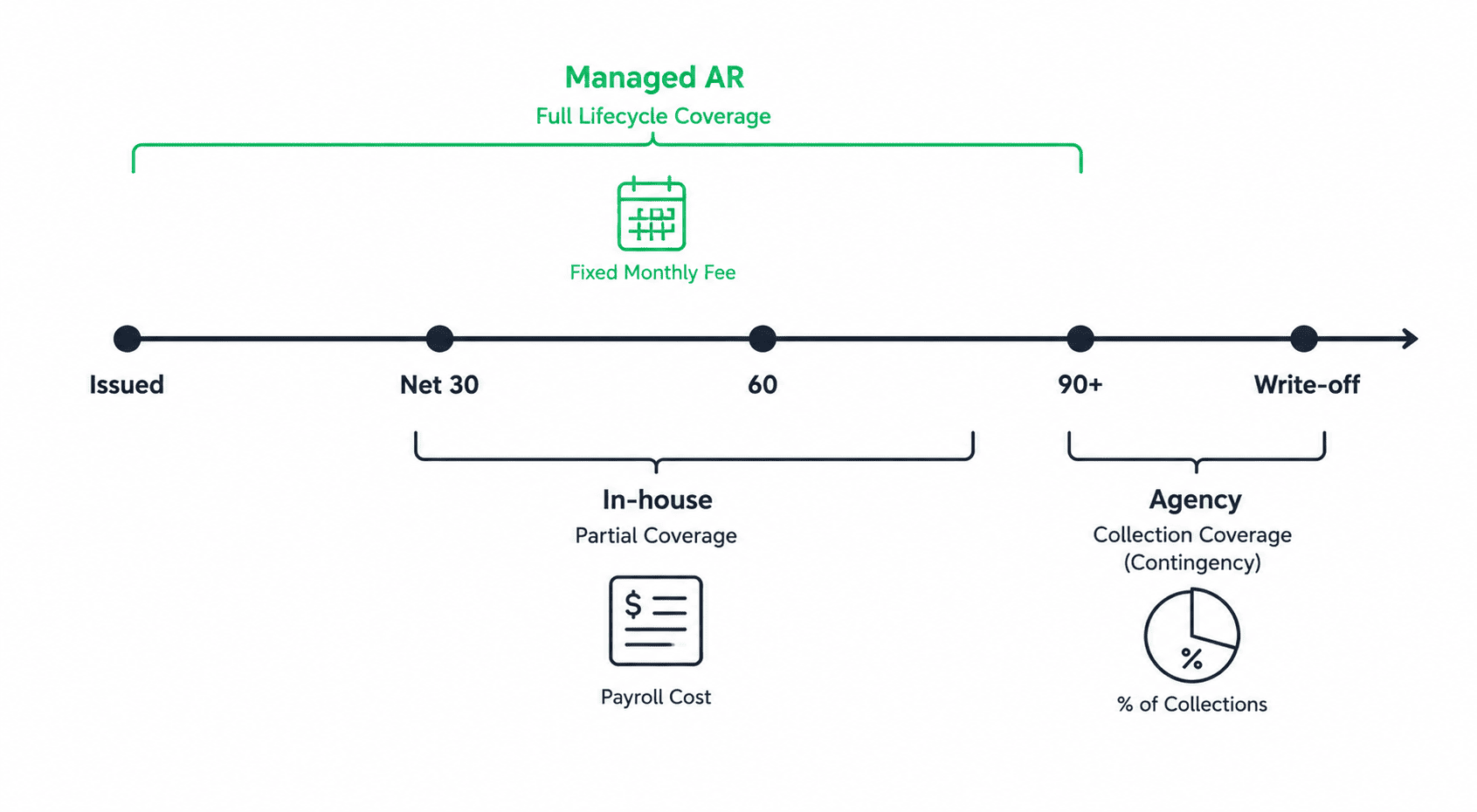
Somewhere past 60 days on the aging report, every freight broker weighs the same three options: keep chasing in-house, hire someone to own it, or hand it to somebody outside. The comparison feels apples to apples. It is not, because the three options do different jobs, start at different points in the invoice lifecycle, and cost money in different ways.
Here is how the three compare for a freight brokerage or 3PL, and how to decide which one the ledger actually needs.
What does a collections agency actually do?
A collections agency takes over accounts you have largely given up on. Placement usually happens past 90 days, after internal follow-up has run out. The agency works the account in its own name, under its own scripts, and is paid on contingency: it keeps a percentage of whatever it recovers, and nothing is owed if nothing comes back.
That structure explains both the appeal and the limits. There is no upfront cost, which is why agencies fit accounts that are already written down. But the percentage on recovered money is steep, the agency works only the accounts you place with it, and the customer relationship rarely survives the referral. An agency also does nothing for the rest of the ledger: no cash application, no dispute handling, no prevention. If a balance is large and the relationship is already gone, a breach of contract claim through an attorney is often weighed against placement at the same time.
What does an in-house collector give you?
An in-house hire gives you the most control. One person inside your office, on your TMS and your phone system, with full context on every customer. For a smaller ledger, that can be enough.
The costs are structural. Salary and benefits run whether the ledger is heavy or light; market ranges for a freight accounts receivable (AR) clerk or small AR team sit around $4K to $8K a month before management time, software, and training. Coverage pauses for vacations and stops entirely at turnover, and the queue is only ever as deep as one person’s day. Short-pays and disputes, the items that take the most digging, are usually what gets deprioritized when the day runs out.
What does managed AR do differently?
A managed accounts receivable desk is a team scoped to your ledger that starts work the day an invoice is issued: receipt confirmation, scheduled follow-up before terms expire, escalation on a fixed ladder, cash application as payments land, and dispute resolution with the POD and the customer rate agreement pulled before the shipper is called.
Because the work starts at issue, most invoices never reach the point where an agency or a write-off is the conversation. The work runs in your name, the customer relationship and the credit decisions stay yours, and the cost is a scoped monthly fee that covers the whole ledger, every week, whether a given invoice is 5 days old or 75.
A worked example: 1,000 loads a month
Put numbers on it. A brokerage moving 1,000 loads a month at an average invoice of $1,000 (a round number for easy math) bills roughly a million dollars a month. At a 55-day DSO, about $1.8 million of that is outstanding at any moment, working capital parked in shipper accounts payable (AP) queues.
Now run each option against that ledger. An in-house AR clerk at $4K to $8K a month can work a slice of it, and the slice shrinks every time volume grows. An agency touches none of it until an account is functionally dead, then keeps a percentage of whatever it recovers. A managed desk works all of it from day one. A structured follow-up cadence alone commonly takes 3 to 7 days off DSO within 60 to 90 days, and more when billing and document delays are fixed alongside it; at these numbers, every 5 days off DSO is roughly $165,000 in freed working capital. The freight DSO and AR benchmarks show the full ranges behind those figures.
How do the three compare on cost?
The structures are hard to compare on a single number, so compare them on what triggers the cost. A hire costs the same every month regardless of results. An agency costs nothing until it recovers, then takes its percentage off the top of money that was already yours. A managed desk is a scoped monthly fee tied to the size of the ledger it runs.
The bigger driver usually sits outside all three: working capital trapped in aging invoices. On freight terms of net 30 to net 45, every extra day of DSO on a few million dollars of annual billings is real money waiting in someone else’s AP queue. The DSO calculator puts a number on that for your own ledger, and the broader playbook is in reducing DSO at a freight brokerage. Composite DSO ranges by company type are published in the freight DSO and AR benchmarks.
When is each the right call?
An agency fits when the account is functionally dead: the relationship is over, the balance is written down, and anything recovered is upside. An in-house hire fits when the ledger is small enough for one person to genuinely cover it and the role can be kept busy and well managed. A managed desk fits when volume has outgrown spare time: follow-up happens in the gaps between dispatch and billing, disputes sit unworked, and the aging report keeps drifting right. The symptoms of that stage are laid out in signs your billing desk is the bottleneck.
The three also stack. A common setup is a managed desk for the whole ledger with an agency held in reserve for the rare account that dies anyway. What a managed desk mostly changes is how rarely that happens.
Five questions to ask before you choose
- How old is the money? If most of the problem is under 60 days, an agency is the wrong tool; if it is all past 120, prevention alone will not recover it.
- Who owns the customer relationship afterward? Agencies work in their own name. If you plan to keep hauling for the account, that matters more than the fee.
- What happens during vacation, illness, and turnover? A one-person desk has a coverage problem; make sure you know how it gets covered before August, not during it.
- Is cash application included? Collections without accurate application produces an aging report nobody trusts, and every option prices this differently.
- What does the aging report look like in 90 days? Ask each option to describe it. The answer tells you whether you are buying recovery, coverage, or a process.
The hidden costs nobody budgets
The cost structures above are the visible part. An in-house desk carries a hidden gap every time the role turns over: recruiting, training, and the weeks where nobody works the ledger at all. An agency carries relationship cost that never shows on the invoice, because its scripts are built for recovery, not retention. And every option that leaves the aging report stale carries the quietest cost of all: credit decisions made on numbers that are weeks old.
None of these show up in a price comparison, and all of them show up in the ledger within a year.
It depends on balance size. On an average freight invoice around $1,000, an agency’s percentage takes a large bite out of a small number, so single stranded invoices are often better worked internally. Agencies make more sense on large aggregated balances where recovering part beats recovering nothing, and where the customer relationship is already gone.
Market ranges for freight billing and AR staff sit around $4K to $8K a month per function before management, software, turnover, and training. A full in-house back office, billing plus AR plus compliance plus oversight, is commonly estimated at $13K to $25K a month for a mid-size brokerage.
Yes, and the combination is common: the desk runs the live ledger from the day invoices are issued, and the rare account that dies anyway gets placed with an agency or an attorney. The two do not overlap, because by the time an agency would take an account, the desk’s job on it is finished.
Want to see what a managed desk would look like on your ledger? Talk to our team. Or email us at info@getclearlane.com.