
How to Collect an Unpaid Freight Invoice: The 30/60/90 Escalation Ladder
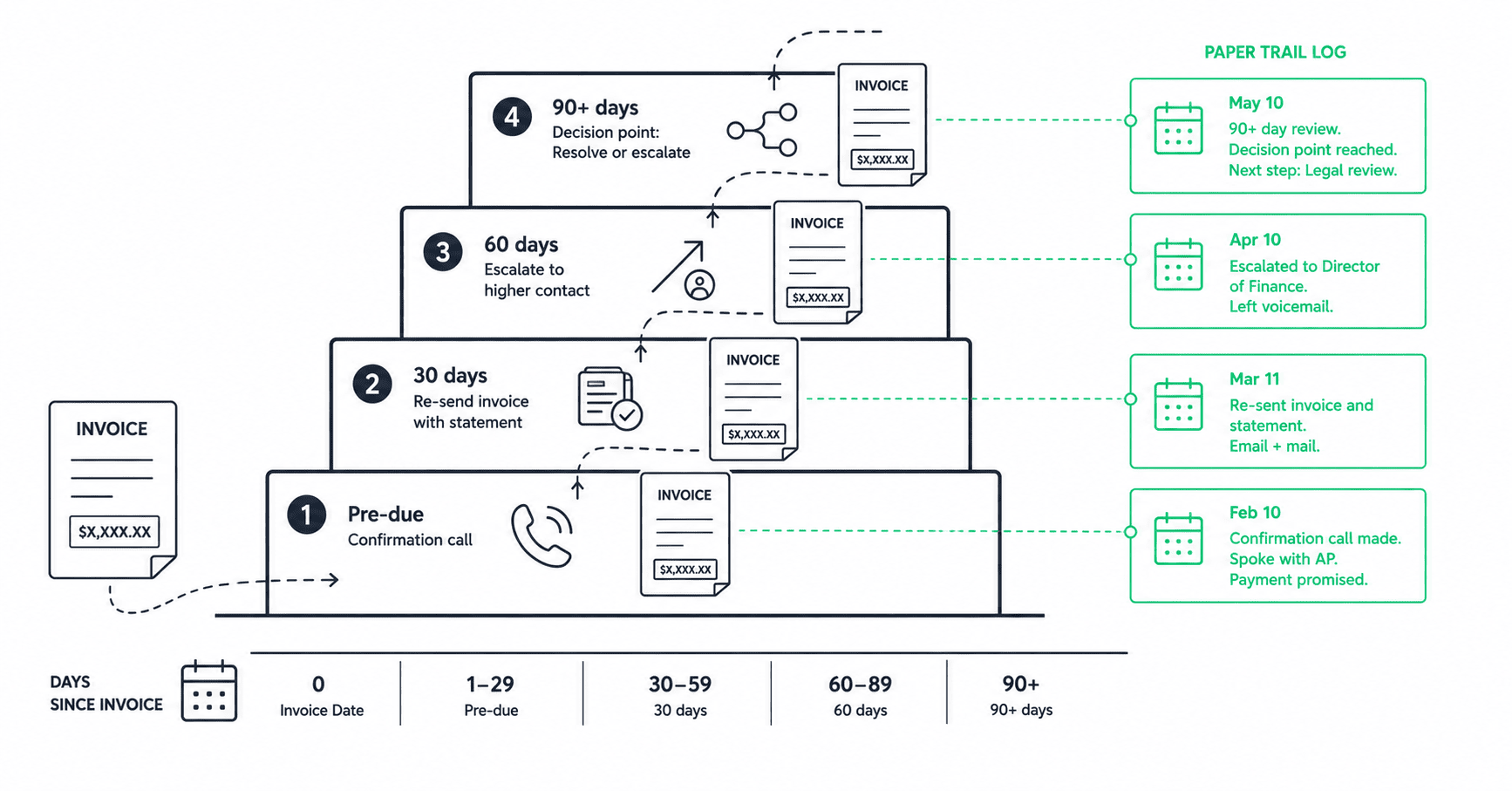
The invoice went out with the POD attached, the terms said net 30, and day 45 has come and gone. Every freight broker and 3PL carries a few of these. What separates an operation that collects them from one that writes them off is rarely effort. It is sequence: knowing what to do at each stage of aging, doing it on schedule, and keeping a record of every step.
This is an escalation ladder for a past-due freight invoice, organized by age. The examples assume an average load value around $1,000 and standard net 30 to net 45 terms, but the sequence holds at any size. Industry data puts average freight DSO between 45 and 65 days, so a portfolio with no ladder at all tends to drift toward the high end on its own.
Why do freight invoices go unpaid?
Most past-due invoices trace to one of four mechanical causes. The invoice never reached the shipper’s accounts payable (AP) queue, because a portal submission failed or an EDI 810 was rejected and nobody saw the rejection. The paperwork is incomplete, usually a missing POD or rate agreement, so the invoice sits unapproved. The shipper short-paid or disputed a charge, most often detention, TONU, or a lumper fee, and the dispute never got worked. Or the shipper has a cash problem of its own and is stretching every vendor it has.
The first three are fixable with process. The fourth is a credit decision. Identifying which one you are dealing with is step one, because each has a different next move. The patterns behind short-pays and how to prevent them are covered in shipper payment disputes: causes and prevention.
What belongs in the invoice packet
Most of the ladder gets easier when the first invoice out the door carries everything the payer needs. A complete packet means nobody can park the invoice on a technicality:
- The invoice itself, with the reference numbers formatted the way this customer requires (PO, BOL, or shipment number)
- The rate confirmation or customer rate agreement showing the agreed linehaul and any accessorials
- The signed proof of delivery (POD), legible, with exception notes if there were any
- Backup for every accessorial charge: detention timestamps, the lumper receipt, the TONU cancellation record
- The remit-to details and terms, stated plainly
Send it complete the first time and half the excuses on this page never come up.
What should happen before the invoice is due?
Collection starts the day the invoice is issued, not the day it goes past due. Confirm the invoice was received and entered into the approval queue. Make one scheduled contact before terms expire to surface any dispute while the load is still fresh and the driver still remembers the dock. Accounting teams call this a dunning cadence, and it is the difference between finding out about a missing POD on day 10 and finding out on day 50. The mechanics of a working cadence are laid out in our guide to the accounts receivable (AR) follow-up cadence.
What do you do at 30 days past due?
Classify before you chase. A delayed invoice and a disputed invoice need different treatment, and treating a dispute like a delay wastes a month. Call the AP contact by name and ask a specific question: is this invoice approved, and what date is it scheduled to pay? Vague check-ins produce vague answers.
Re-send the complete packet in the same thread: invoice, rate confirmation, POD, and backup for any accessorial charge. If the customer bills through a portal or EDI, log in and confirm the submission was accepted rather than assuming it was. Get a commitment date and write it down. Log every contact with a date, a name, and what was said. That log is what turns a later escalation, or a legal claim, from your word against theirs into a record.
What to say at 30 days
Vague check-ins get vague answers, so ask questions that force a specific reply:
- “Can you confirm invoice 4471 is in your approval queue, and is anything missing from the packet?”
- “Is this invoice approved and scheduled, or is something on it in question?” This one sorts a delay from a dispute in a single sentence.
- “What date is this scheduled to pay, and who should I follow up with if that date slips?”
Each answer goes in the log with a date and a name. The question about who to follow up with matters more than it looks: it turns the next call from a cold chase into a referral.
What changes at 60 days past due?
At 60 days the AP queue has had two full cycles, so the queue is no longer the explanation. Move up a level. Contact the person who awarded you the freight and ask for help getting the invoice unstuck. Most operational contacts do not know their AP department is sitting on a vendor’s money, and most want the freight relationship intact.
If the shipper acknowledges the balance but cannot clear it at once, a short written payment plan beats an open-ended promise. And make the credit call deliberately: whether you keep covering new loads for an account that is 60 days behind is a business decision, not something that should happen by default because dispatch did not know.
What to say at 60 days, and what a payment plan needs
The 60-day call goes to the person who gave you the freight, and it works best as a request for help: “We have four invoices totaling $6,200 past 60 days. AP has had the packets for two full cycles. Can you help me find out where they are stuck?” Most operational contacts respond to that, because it is their vendor relationship on the line.
If the answer is a payment plan, it needs four things in writing to be worth anything: the total balance acknowledged, fixed payment dates rather than intentions, what happens with new loads while the plan runs, and a signature from someone with authority over payables. A plan missing any of these is a delay wearing a plan’s clothes.
What are your options at 90 days and beyond?
At 90 days the choices narrow to four, and each has a cost. A final demand letter with a specific deadline and a specific consequence sometimes shakes an invoice loose on its own. A collections agency will take the account on contingency, keeping a percentage of whatever it recovers, and the customer relationship rarely survives the referral. Small claims court works for balances inside your state’s limit, though some states require a corporation or LLC to appear through an attorney, so check the rule before filing. Watch the clock too. For carriers, 49 U.S.C. 14705(a) sets an 18-month window to sue for transportation charges, shorter than most state contract deadlines. Brokers fall under state contract law, but 18 months is a sensible internal cutoff either way. For larger balances, an unpaid freight invoice is a breach of contract claim, and an attorney’s demand letter costs less than most people expect.
Whichever route you take, the contact log and the document packet from the earlier rungs are what make it work. Deadlines for contract claims vary by state, so if a meaningful balance is heading that way, involve a lawyer sooner rather than later. This article is general information, not legal advice.
What a final demand letter includes
- The exact balance and a list of every open invoice by number, date, and amount
- Copies of the invoice, rate confirmation, and POD for each one, so there is nothing left to request
- A specific deadline, commonly 10 business days, not “at your earliest convenience”
- The specific next step after the deadline: placement, small claims filing, or attorney referral, whichever you actually intend
- Delivery by email and by certified mail, so receipt is provable later
The letter works when the paper trail behind it is complete, which is why the earlier rungs of the ladder matter even for accounts that end up here.
How do you keep invoices from reaching 90 days?
The ladder works, but every rung costs more than the one before it. The cheapest fix is the first rung: invoices that go out clean and get worked from day one rarely see 60. That takes a daily follow-up cadence that does not depend on someone remembering, accurate cash application so the aging report reflects reality, and dispute handling that pulls the paperwork instead of re-sending the same invoice into silence.
Running all of that consistently is what a managed AR and collections desk is for. To see what your current aging is costing you in working capital, run your numbers through the DSO calculator, and the wider playbook is in reducing DSO at a freight brokerage.
What aging invoices cost while you wait
At freight’s average load value of about $1,000, a hundred aged invoices is $100,000 of your working capital sitting in someone else’s accounts payable queue. On a million dollars of monthly billings, every 10 days of DSO is roughly $333,000 you cannot deploy toward carriers, payroll, or growth.
That is why the ladder is worth running as a process rather than a rescue. For context on where freight operations typically sit, the freight DSO and AR benchmarks publish composite ranges by company type, including how aging distributes before and after collections get structured.
Frequently Asked Questions
After the ladder is exhausted, which usually means past 90 days, after a final demand has expired, and after you have decided the customer relationship is already gone. An agency keeps a percentage of what it recovers and works only the accounts you hand it, so treat it as the last rung once your own process has run out.
Only if your customer contract or credit terms provide for them, and enforceability varies by state. A late fee clause you never enforce still has value as leverage in a payment plan negotiation. If your paperwork is silent, adding a fee after the fact rarely holds up.
No. Factoring companies buy invoices at issue, and most will not advance against receivables that are already aged. Factoring changes when you get paid on future loads, at a discount. For an invoice that is already past due, the ladder above is the path.
If the ladder sounds like a full-time job, that is because past a certain volume it is. Talk to our team to see how a dedicated AR desk runs it inside your TMS. Or email us at info@getclearlane.com.