
What Happens When You Hand Off the Administrative Side of a Freight Brokerage
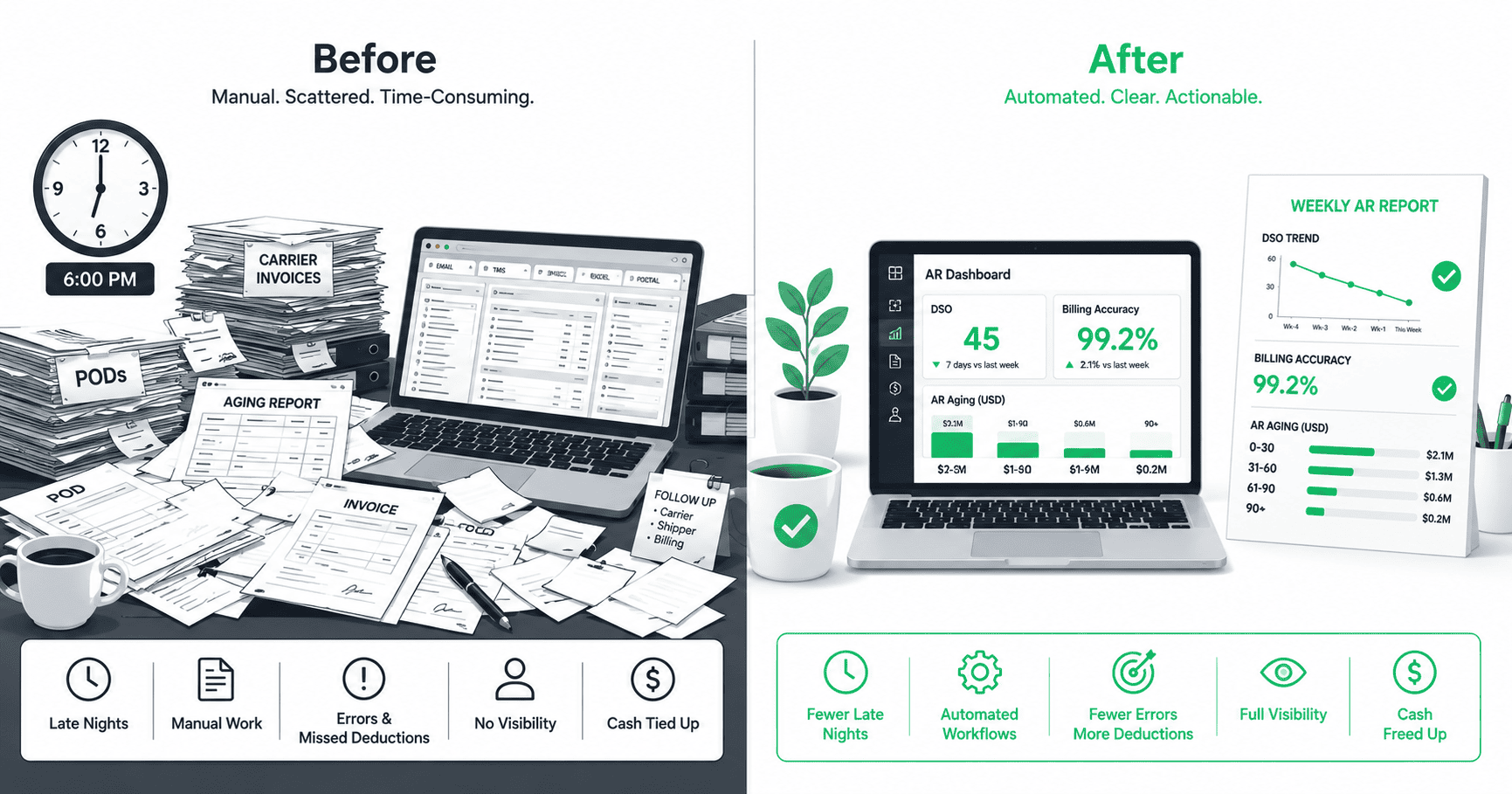
Ask the owner of a mid-size brokerage what they did after 6pm last night and the answer is rarely sales. It is a missing POD someone promised to send by noon. A carrier invoice that does not match the rate confirmation. The third follow-up on a shipper invoice that is 52 days old. The loads moved fine. The paperwork behind them is what follows you home.
The administrative side of a freight brokerage is everything that happens after dispatch books the load: collecting delivery documents, verifying carrier invoices, sending shipper invoices, following up on receivables, watching carrier compliance, and keeping the books straight. None of it wins new freight. All of it decides whether the freight you already moved actually turns into cash.
We have covered the mechanics of the transition before in our walkthrough of the first 30 days of outsourcing back-office operations. That post follows the process. This one follows the person. Here is what changes for the owner when the administrative side of the business stops living on your desk.
What Counts as the Administrative Side?
Owners tend to underestimate this list because no single item on it feels heavy. Together, they are a full-time function:
- Chasing PODs and rate confirmations from carriers after every delivery
- Verifying carrier invoices against rate confirmations before anything gets paid
- Building and sending shipper invoices with the right backup attached
- Following up on receivables and working the aging report
- Onboarding carriers and tracking authority, insurance, and safety ratings
- Recording and reconciling all of it in the books
Some of this is not optional even when cash flow is fine. Brokers are required to keep records of every transaction under 49 CFR Part 371, and every carrier you cover must have its required FMCSA insurance filing on file. Clean files are a legal baseline, not a nice-to-have. The full menu of what can be handed off is on our services page; the short version is: all of the above.
The Week Before the Handoff
The handoff starts with a discovery pass, not a contract signature. The incoming team maps how your shipment files are organized, where rate confirmations live, which customers need invoices through portals or EDI, and what your billing rules actually are, including the exceptions that only exist in your head.
Nothing migrates. The team works inside your existing TMS with their own credentials, follows your workflows, and documents them into a playbook as they go. For most brokerages that discovery-to-production window runs about two to three weeks, with full volume by week four. The step-by-step is on our how it works page.
Your job that week is honest answers. The handoff goes fastest when the messy parts surface early: the customer who short-pays unless detention has a gate ticket attached, the carrier who emails PODs to an inbox nobody checks.
What You Stop Doing First
The first thing that disappears is the document chase. PODs start coming back within 24 hours of delivery without anyone in your office sending the request, because someone is now assigned to exactly that. If you want the before-and-after math on this one task, we broke it down in our comparison of in-house and outsourced POD retrieval.
The second is line-by-line invoice review. Every carrier invoice gets checked against its rate confirmation before payment, and you only hear about the ones that fail: the duplicate, the rate mismatch, the accessorial nobody authorized. You go from reviewing everything to deciding on exceptions.
The third is the accounts receivable (AR) follow-up you have been doing on Saturday mornings. A structured collections cadence replaces the guilt-driven one. Invoices get followed up on schedule, disputes get worked while they are fresh, and balances stop aging simply because nobody had time.
By the end of the first month, the pattern is set: the work still happens, every day, on every load. It just stops being your evening shift.
What You Keep, and Should Never Hand Off
Handing off the administrative side does not mean handing off authority. The things that make your brokerage yours stay exactly where they are: pricing, customer relationships, carrier network strategy, and final say on what gets paid and when. Escalations come to you with the file already assembled, so the decision takes minutes instead of an afternoon of digging.
A good way to think about it: tasks move, judgment stays. If a back-office partner asks for authority over your bank account or your customer relationships, that is not outsourcing. That is a red flag.
What You See Instead: Reports, Not Tasks
The owner experience after the handoff is mostly a change in what you look at. Instead of doing the work, you read a weekly report that shows DSO trend, aging by bucket, billing exceptions caught, and accessorial charges recovered before invoicing. You manage outcomes instead of keystrokes.
That visibility is usually better than what owners had when the work was in-house, because in-house admin rarely produces reporting; it is too busy doing the work. One mid-size brokerage watched its DSO drop from 58 days to 41 over six months, and the owner could see the curve bend week by week in those reports.
What It Costs vs. What It Frees
Run the staffing math first. In-house billing, AR, and compliance coverage typically costs $13K to $25K per month in salaries alone before training, turnover, software seats, and the management time those people need. We published the full breakdown in the true cost of in-house back-office staffing. Outsourced pricing scales with your operation and can scale back down when volume dips, which fixed payroll never does.
But the number owners mention later is not the payroll delta. It is the hours. The 6pm POD chase, the month-end invoice review, the Saturday aging report: that time goes back into lanes, customers, and occasionally a weekend. The administrative side of the business is the part of ownership nobody signed up for. It is also the most transferable.
The Concerns That Keep Owners From Doing This
Control. You set the billing rules, the approval thresholds, and the escalation paths; the team executes inside them. Between the playbook and the weekly reporting, most owners end up with more control over the back office than they had before, not less.
Quality. Accuracy is the whole product. Every invoice verified against its rate confirmation, a 99 percent accuracy target, and exception handling that surfaces problems instead of burying them. Ask any prospective partner how they handle a mistake they caused; the answer tells you everything.
What customers notice. Invoices that arrive on time with the right paperwork attached, and fewer disputes. Your customers do not see a vendor; they see a brokerage that suddenly bills like a much bigger company. The rest of the common questions are answered on our FAQ page.
How to Start Without Betting the Company
Almost nobody hands off the entire administrative function on day one, and you should be suspicious of any partner who suggests it. Start with the task that hurts most. For most brokerages that is POD chase or carrier invoice verification: contained, measurable, and painful enough that the before-and-after is obvious within two weeks.
Expand from there as trust builds. The owners who end up with the full handoff (billing through bookkeeping) almost all started with one function and a measured SLA. The destination is the same either way: you keep dispatch, sales, and the relationships. The paperwork finally belongs to someone whose entire job is the paperwork. If you run a brokerage, the specifics for your model are on our freight brokers page.
Frequently Asked Questions
Yes. A full back-office engagement covers POD retrieval, carrier invoice verification and AP prep, shipper invoicing, AR and collections, carrier onboarding and compliance monitoring, and optionally bookkeeping. Most brokerages start with one function and expand as trust builds rather than handing everything off on day one.
Pricing, customer relationships, carrier network strategy, final payment approvals, and escalation decisions. The operational tasks move to the outsourced team; the authority and judgment stay with the owner, supported by weekly reporting instead of day-to-day task work.
About two to three weeks to production for most mid-size brokerages, with full volume by week four. Discovery and access happen in week one, supervised production in week two, the volume ramp in week three, and full production with defined SLAs in week four.
Want to see what your week looks like without the admin load? Talk to our team and we will map your post-dispatch workflow in a 20-minute call. Or email us at info@getclearlane.com.