
In-House vs Outsourced POD Retrieval: A Cost and Speed Comparison
Why Is POD Retrieval the Function That Sets the Billing Clock?
Every freight billing cycle starts with the same document: a signed proof of delivery. The shipper invoice can’t be prepared until the POD is retrieved, verified, and uploaded to the TMS. No invoice means the payment clock hasn’t started, and the cash sits with the customer until it does.
POD retrieval is the first domino. When it falls on time (within 24 hours of delivery), the entire downstream pipeline runs on schedule. When it runs late, billing is delayed, DSO rises, and cash flow tightens.
Most freight companies understand this. The question isn’t whether POD retrieval matters. It’s how to staff it. The two options are handling it with the existing in-house team or bringing in a dedicated external operation. Both approaches work. Both have real tradeoffs worth understanding before making the decision.
What Are the Advantages and Challenges of In-House POD Retrieval?
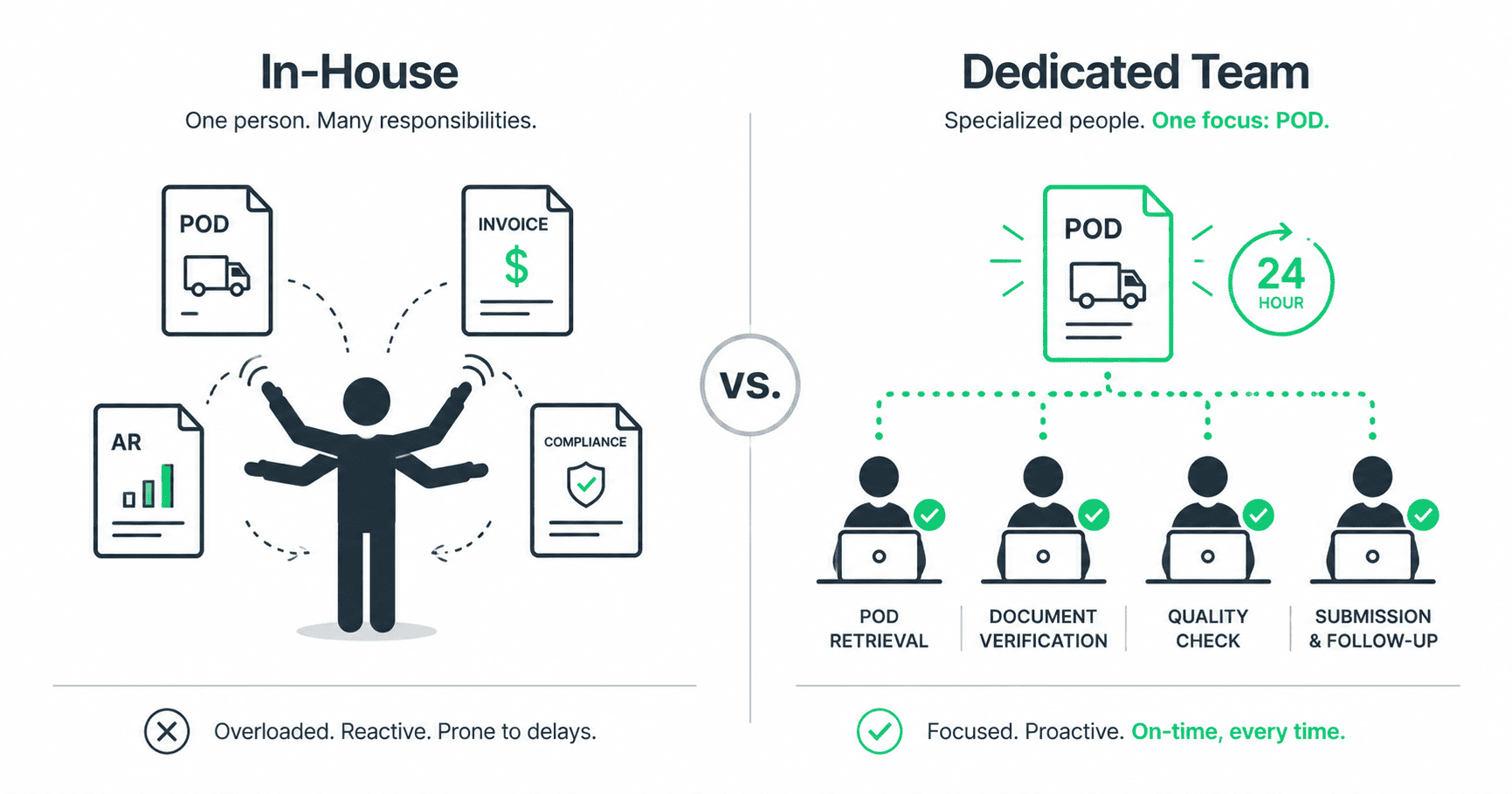
At most growing freight brokerages, POD retrieval is handled by the same team that does shipper billing, accounts receivable (AR) follow-up, carrier compliance, and general exception handling. There’s rarely a person whose sole job is chasing PODs. It’s one of several responsibilities shared across a two-to-four-person back-office team.
The advantages of this model are real. The in-house team knows the carriers personally. They know which ones upload PODs to a portal automatically, which ones respond to emails quickly, and which ones need a phone call to their dispatcher. That institutional knowledge speeds up the process for carriers they work with regularly.
The in-house team also has direct access to internal systems and communication channels. When a POD issue connects to a broader carrier relationship question (a pattern of late documentation, a billing dispute, a compliance flag), the in-house team can escalate through the same relationships they manage day-to-day.
And there’s the control factor. When POD retrieval is in-house, the operations manager or owner can see the work happening, adjust priorities in real time, and intervene directly when something isn’t moving fast enough.
The challenges of the in-house model are equally real, and they’re almost entirely about capacity.
At 1,000 loads per month, a shared back-office team can usually handle POD retrieval alongside other responsibilities. The volume is manageable, and the team has enough bandwidth to chase each load individually.
At 2,000 to 4,000 loads per month, the math changes. The fully loaded cost of each back-office employee runs $75,000 to $95,000 annually. A three-person team at that cost represents $225,000 to $285,000 per year. That team is splitting their time across POD retrieval, billing, AR, compliance, and exception handling. POD work might get 20 to 30% of their collective capacity, roughly 100 to 150 hours per month.
At 3,000 loads per month, 100 to 150 hours of POD work means roughly 2 to 3 minutes per load for retrieval and verification. A dedicated specialist works at about the same average, so the minutes are not the problem. The problem is that a shared team gets those minutes in fragments between billing, AR, and compliance work. That’s manageable for carriers who upload documents automatically. It breaks down for carriers who need follow-up calls, portal navigation, or escalation, because those loads need timely repeat attempts, not a few minutes whenever the queue allows.
The result is triage. The team chases the easy PODs first (auto-uploads, responsive carriers), then works through the harder ones as time allows. Average turnaround drifts from 24 hours toward 48 to 72 hours. Some loads stretch past a week. The POD retrieval process loses its consistency. The team is capable. The problem is split attention across too many functions.
Coverage gaps compound the issue. When one person on a three-person team takes a week of vacation, the remaining two absorb 50% more work. POD retrieval, being less urgent than an invoice that’s due or a dispute that needs resolution, is typically what gets deferred during short-staffed periods.
What Are the Advantages and Challenges of Outsourced POD Retrieval?
An outsourced POD retrieval operation is a dedicated team that does one thing: retrieve, verify, and upload PODs. They work inside the broker’s TMS, follow a defined escalation cadence, and process every load on the same timeline regardless of dollar value.
The advantages center on capacity and consistency.
A dedicated team doesn’t triage PODs because they don’t have competing priorities. Every load gets chased on the same schedule: first check within hours of delivery confirmation, first outreach if the POD isn’t available by hour four to six, escalation by hour 12 to 16, exception flagging at 24 hours. The cadence runs the same on Monday as it does on Friday, and it doesn’t change when someone takes a vacation.
The capacity scales with volume. If load count goes from 2,000 to 3,000 per month, the outsourced team adds capacity to match. The broker doesn’t need to recruit, hire, and train a new employee. The team adjusts. If volume drops, the capacity adjusts downward. The cost structure flexes with the business rather than staying fixed.
The economics typically run below the fully loaded cost of equivalent in-house capacity. The work isn’t done less carefully. The savings come from a dedicated operation achieving higher utilization rates. A three-person in-house team has to cover vacations, sick days, and turnover gaps. A dedicated outsourced operation absorbs those through team depth and cross-training.
And the turnaround is measurable from day one. A well-run outsourced POD operation targets retrieval within 24 hours of delivery on 85%+ of loads, with the remainder on a documented exception process. That benchmark is consistent because the team’s capacity is allocated entirely to POD work.
The challenges of outsourcing POD retrieval are worth naming honestly.
Communication overhead exists. The outsourced team needs clear instructions on TMS navigation, carrier communication preferences, and escalation protocols. There’s a setup period (typically one to two weeks) where the team learns the broker’s specific workflows and carrier mix.
Institutional knowledge about specific carrier relationships takes time to develop. An in-house person who’s worked with a carrier for two years knows that calling the dispatcher’s cell phone on Thursdays gets a faster response than emailing the general inbox. An outsourced team learns these patterns through data and experience, but it takes a few weeks to build that carrier-specific knowledge.
There’s a dependency factor. When a mission-critical function is handled by an external team, the broker needs confidence that the team will perform consistently. That means defined SLAs, regular reporting, and a clear escalation path when something isn’t working.
And for brokerages that value having all operations under one roof (for cultural, security, or management preference reasons), outsourcing any function involves a philosophical shift that goes beyond the cost analysis.
The Cost Comparison
For a brokerage processing 3,000 loads per month, the approximate cost comparison looks like this:
In-house: one dedicated POD specialist at $55,000 base salary, fully loaded to roughly $75,000 to $85,000 annually. That person handles approximately 3,000 loads per month if POD retrieval is their only function. Realistic output: 2,500 to 3,000 loads per month with consistent 24-hour turnaround, assuming no competing responsibilities. Add coverage for vacations and sick days (either overtime for colleagues or temporary help), and the effective annual cost is closer to $85,000 to $95,000.
Outsourced: a dedicated POD team handling 3,000 loads per month, priced as a function rather than headcount, with coverage that does not disappear with PTO or turnover. The exact number depends on the provider, the complexity of the carrier mix, and the SLA requirements. The cost includes coverage for all team absences, consistent daily capacity, and defined turnaround targets.
The cost difference alone doesn’t make the decision. The value comparison includes time-to-capacity (immediate for outsourced vs. 4 to 8 weeks recruiting plus 30 to 60 days training for in-house), consistency (no coverage gaps vs. periodic gaps during PTO and turnover), and scalability (flex capacity vs. fixed headcount).
When Should a Freight Company Outsource POD Retrieval?
In-house POD retrieval makes the most sense when the brokerage is below 1,500 loads per month and the back-office team has genuine capacity to handle it alongside other responsibilities. It also works when the carrier mix is small and relationship-dependent: a brokerage working with 30 carriers they’ve used for years, where personal relationships drive documentation speed.
Outsourced POD retrieval makes the most sense when load volume exceeds what the back-office team can handle consistently, when turnaround times have drifted above 24 hours, when DSO is trending up and POD delays are a contributing factor, or when the brokerage is in growth mode and needs capacity that can scale with the business without the 4-8 week recruiting delay.
Many brokerages end up with a hybrid: in-house ownership of the carrier relationship and exception escalation, with an outsourced team handling the daily volume of portal checks, outreach, follow-up, verification, and TMS uploads.
Metrics That Guide the Decision
If you’re evaluating whether your current POD process needs more capacity (in-house or outsourced), these numbers tell the story:
Average POD turnaround time. If it’s consistently above 24 hours, you have a capacity problem. Track it weekly.
POD retrieval rate at 24 hours. What percentage of loads have a verified POD within 24 hours? Below 80% is a signal.
Correlation between POD turnaround and invoice cycle time. If your invoices are going out 72 hours after delivery and your PODs are arriving at 48 hours, the 48-hour POD turnaround is directly causing a 48-hour billing delay.
Back-office overtime hours. If the team is consistently working overtime to keep up with POD volume, the capacity constraint is already affecting quality and retention.
Cost per load. Divide your total back-office labor cost by monthly load count. If that number is increasing as you grow, your cost structure isn’t scaling.
ClearLane’s POD retrieval service targets 24-hour turnaround with verification and TMS upload included, as part of the full post-dispatch pipeline. No recruiting delay, no training ramp, no coverage gaps.
Frequently Asked Questions
Yes. POD stands for proof of delivery, the signed document confirming a shipment was delivered. In freight brokerage, POD retrieval speed directly affects how fast you can invoice the shipper and start the collections clock.
In-house POD retrieval is handled by the existing back-office team alongside billing, AR, and compliance. Outsourced POD retrieval uses a dedicated team that does nothing but retrieve, verify, and upload PODs, providing consistent 24-hour turnaround without competing priorities.
Outsourced POD retrieval typically costs less than the fully loaded cost of equivalent in-house capacity: no recruiting, no ramp time, and dedicated teams don’t have coverage gaps from PTO or turnover.
When load volume exceeds 1,500 per month and POD turnaround has drifted above 24 hours, when DSO is trending up and POD delays are a contributing factor, or when the brokerage is in growth mode and needs capacity that scales without the recruiting delay.
The target is 85% or more of loads with a verified POD within 24 hours of delivery. Below 80% signals a capacity problem that needs dedicated attention.
Want to compare your current POD costs and turnaround? Talk to our team to walk through the numbers. Or email us at info@getclearlane.com.
Related reading: POD chase best practices and cutting POD turnaround from 72 to 18 hours. The workflow itself is described on the POD retrieval page.