
What Lenders Ask Freight Brokers For, and When They Ask For It
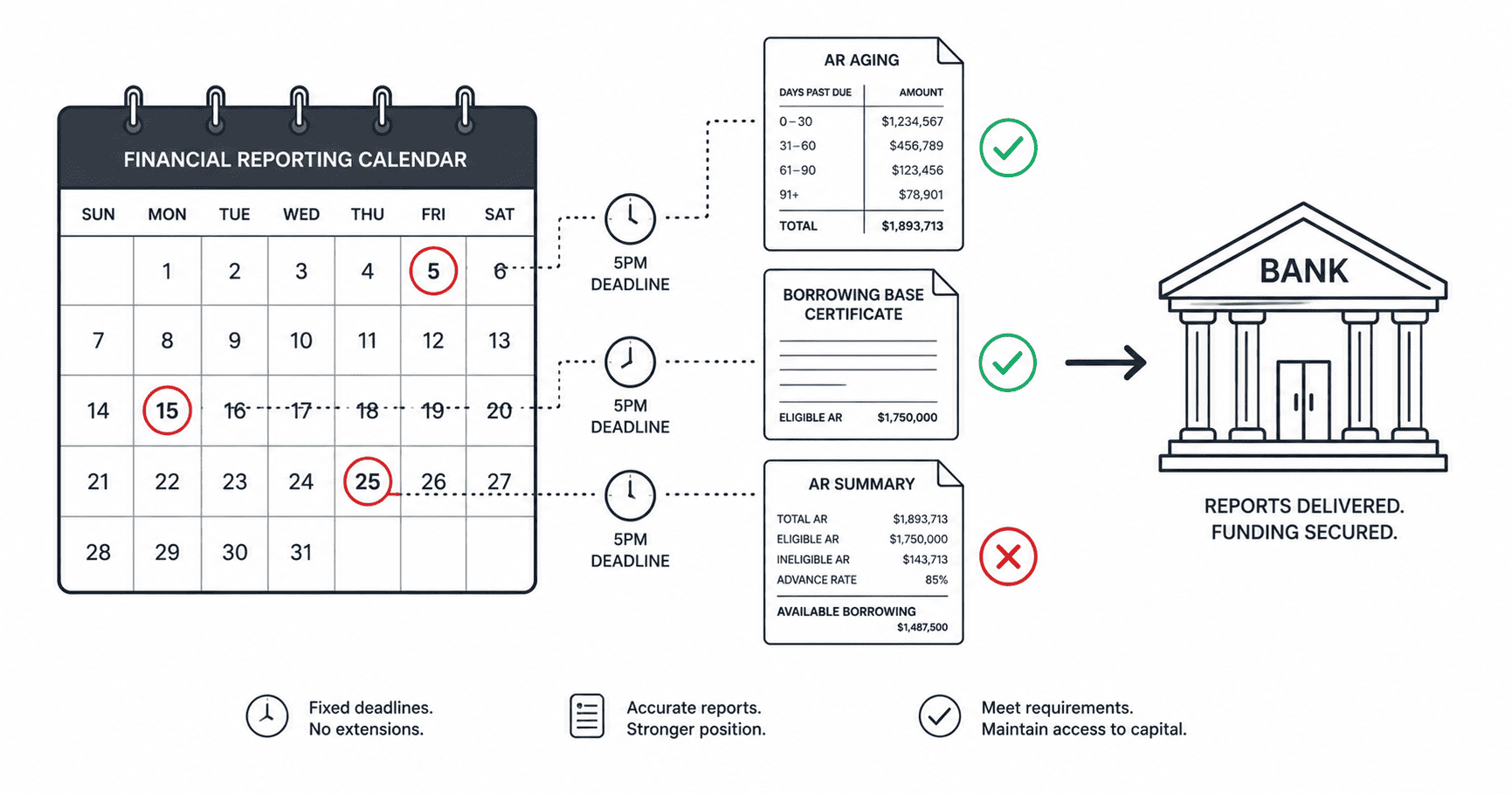
A credit facility comes with a reporting schedule, and that schedule is written into the agreement before the first dollar is drawn. It does not move because a shipper paid late, because the billing clerk was out, or because the month got busy. The dates are the dates.
For a lot of freight companies, that is the moment reporting stops being an internal exercise. Management reporting can slip a week and nobody outside the building notices. Lender reporting cannot, because someone outside the building is holding the covenant.
Why Does a Freight Lender Ask for More Than a Profit and Loss Statement?
Most freight credit facilities are secured by receivables. The money a broker or carrier is owed by its shippers is the collateral. Under Article 9 of the Uniform Commercial Code, those receivables are defined as accounts, and a lender holding a security interest in them has a direct stake in their quality, not simply in whether the company turned a profit.
That changes what the lender wants to see. A profit and loss statement says the operation made money. It does not say whether the accounts receivable (AR) behind the loan are collectible, concentrated in three customers, or quietly aging past the point where they still count toward borrowing capacity. So the package goes deeper than the financials a management team would produce for itself.
What Is a Borrowing Base Certificate, and What Does It Require?
A borrowing base certificate tells the lender how much the company is entitled to borrow this period. It is built from eligible receivables, meaning the invoices the agreement says may count toward the loan.
The word doing the work is eligible. Most agreements exclude whole categories. Common exclusions include invoices past a stated age, often 90 days, balances from a single customer above a concentration limit, amounts in dispute, receivables owed by related companies, and foreign receivables, which matters for anyone running cross-border freight.
So producing the certificate is not a matter of exporting an AR total. Someone has to apply the agreement definitions to the aging report line by line and be able to show how each exclusion was calculated. A certificate that overstates the base is a problem. A certificate that understates it quietly costs the company borrowing capacity it was entitled to use.
What Are Covenant Compliance Schedules?
Covenants are the promises inside the credit agreement. A covenant compliance schedule is the periodic proof the company kept them.
The specific tests vary by facility, but freight agreements commonly measure a minimum fixed charge coverage ratio, a maximum leverage ratio, minimum tangible net worth, or a ceiling on capital expenditures. The schedule shows the calculation with its inputs, in the format the agreement defines.
Two things make this harder than it sounds. First, the agreement definitions rarely match the accounting software defaults. EBITDA in a credit agreement is a defined term with its own add-backs and exclusions, and it is not whatever the accounting system happens to label EBITDA. Second, the calculation has to be reproducible. A lender who cannot follow the arithmetic will ask, and those questions tend to arrive at the least convenient moment.
What Calendar Does Lender Reporting Run On?
Most facilities stack several cadences on top of each other:
- Borrowing base certificates, often monthly, and weekly on tighter facilities or during a stressed period
- AR aging and accounts payable aging, usually delivered alongside the borrowing base
- Internal financial statements, monthly, commonly due 30 days after month end
- Covenant compliance certificates, quarterly, commonly due 45 days after quarter end
- Annual financial statements, on a longer clock, typically prepared or reviewed by the company CPA
The exact days live in the agreement. The pattern that matters is that these compound. A company that closes slowly is late on the borrowing base, which delays the aging, which pushes the covenant certificate to the wire. Everything above depends on the close landing on a predictable date.
Why Does the Reporting Have to Hold Up Independently?
There is a structural point underneath all of this, and it has nothing to do with anyone being dishonest.
The person recording transactions is reporting on the operation they work inside every day. They chose the categorizations, they know which invoices are contested, and they are measured on some of the same figures. That is workable for running the business. It is a weaker position when an outside party is making a lending decision from the output.
Lenders understand this, which is why they ask for consistency and traceability rather than taking figures at face value. A package that reads the same way every month, where each number traces back to the loads and invoices underneath it, draws far fewer questions than one that changes shape depending on who assembled it.
What Happens When Lender Reporting Slips?
Late reporting is usually a technical default under the agreement, separate from missing a financial covenant. Most agreements allow a cure period, and most lenders would rather receive the report than exercise a remedy.
The practical cost arrives well before any remedy does. A lender who has to chase reporting starts watching the account more closely. Requests get more frequent and more detailed. The relationship shifts from routine to supervised. For a company that may later want to expand the facility, refinance, or explain a rough quarter, that history follows it.
How Should a Freight Company Set This Up?
Three things make lender reporting boring, which is the entire goal.
Start from the agreement, not from the software. Someone should read the reporting section and the definitions, then build the package to those definitions rather than to whatever the accounting system produces by default.
Close on a fixed date. Lender reporting sits downstream of the close, and the aging that feeds it depends on invoices going out on time and receivables being worked systematically. A slow close and a drifting DSO show up in the borrowing base as reduced capacity, which is working capital the company earned but cannot access.
Separate assembly from operations. The numbers should be put together by someone who is not being measured by them, and presented the same way every period. That is the whole of what owner, lender, and transaction reporting is for.
Lender reporting is not harder than management reporting. It is less forgiving, because the deadline belongs to somebody else.
Frequently Asked Questions
A periodic document telling the lender how much the company may borrow, calculated from eligible receivables. The credit agreement defines eligibility, commonly excluding invoices past a stated age such as 90 days, balances above a customer concentration limit, disputed amounts, related-party receivables, and in many cases foreign receivables.
It varies by facility, but a common pattern is a monthly borrowing base certificate with AR and AP aging, monthly internal financial statements due about 30 days after month end, quarterly covenant compliance certificates due about 45 days after quarter end, and annual statements on a longer clock. Tighter facilities may require the borrowing base weekly.
Late delivery is typically a technical default under the agreement, separate from missing a financial covenant, and most agreements provide a cure period. The more immediate cost is usually the shift in the relationship: a lender who has to chase reporting tends to monitor the account more closely and ask more questions.
No. ClearLane prepares management and lender reporting packages: borrowing base support, covenant compliance schedules, AR aging, and per-entity or combined statements on the agreement calendar. Audited, reviewed, and tax-basis statements stay with your CPA.
Reporting to a lender on their calendar instead of yours? Request a demo to see what a lender package looks like for your facility. Or email us at info@getclearlane.com.