
Managed Back Office vs Automation Software for Freight Companies
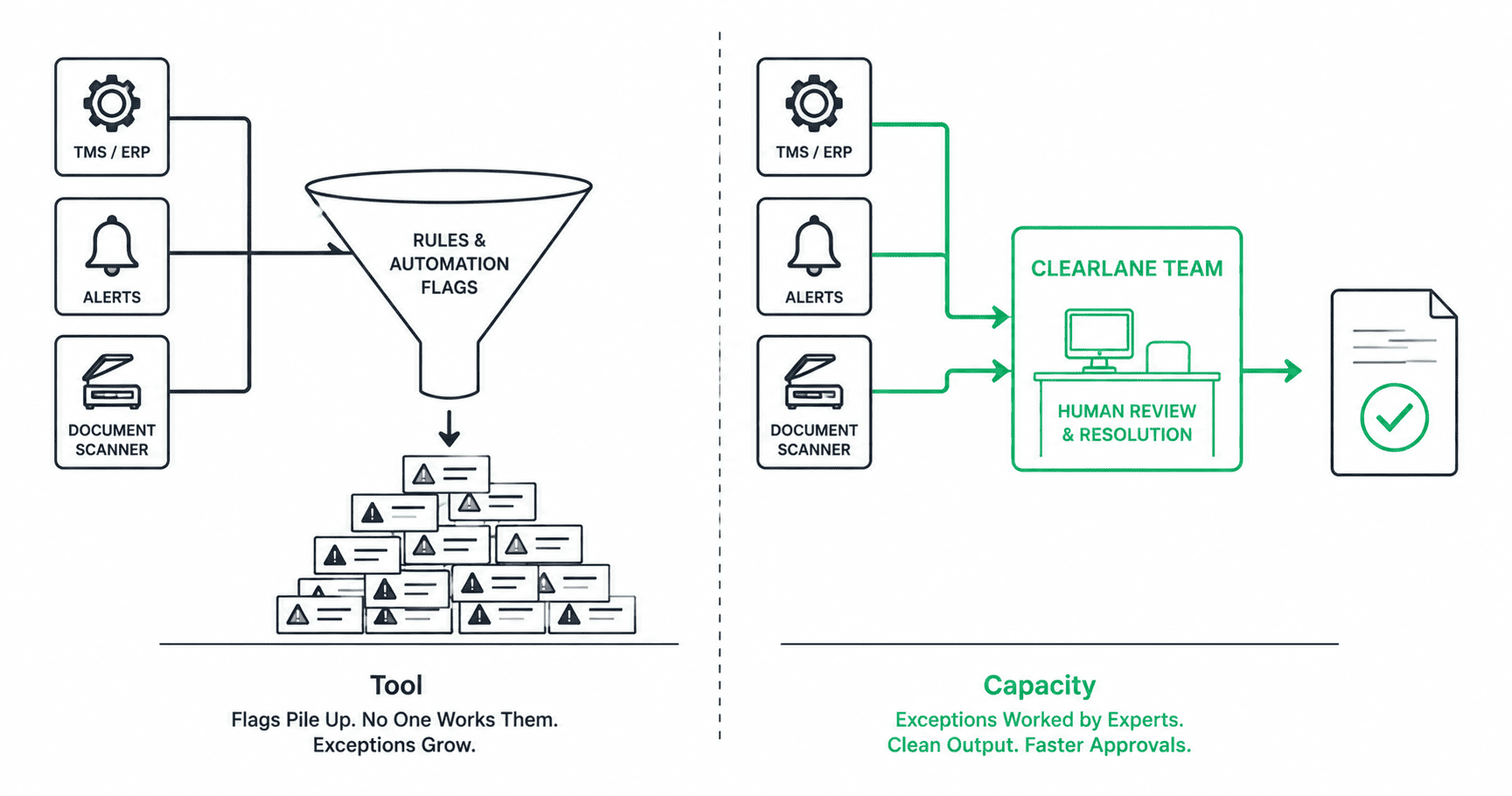
The pitch for back-office automation is compelling: software does the billing, chases the documents, sends the reminders, and your team shrinks to whoever watches the dashboards. The pitch for a managed back office sounds similar from a distance: hand the functions off and stop thinking about them. They are not the same purchase, and companies that confuse them usually end up owning both problems. Here is the difference across the whole back office, not just one desk.
What is each one actually selling?
Automation software sells execution of rules. If X, then Y, at any volume, instantly. A managed back office sells accountability for outcomes: invoices out the day the POD lands, receivables worked on a cadence, carrier files complete, with a team responsible when any of it slips. One is a tool your operation uses. The other is capacity your operation gains.
Where does automation carry a freight back office?
Further than skeptics admit. Document capture, invoice matching, scheduled payment reminders, and reporting are genuinely automatable, and every strong back office (in-house or managed) runs on them. The audit-specific version of this argument is its own post: freight audit software vs managed audit. The managed half of that comparison is a carrier invoice audit desk that works the exceptions the software flags. The pattern generalizes: automation is excellent at the work that never requires a decision.
Where does the whole-back-office version break down?
Freight operations are decision-dense. Which customer gets a firm call versus a gentle reminder is a judgment that moves DSO, which is why reducing DSO is a process problem before it is a software problem. Whether a carrier stays on the load board after an insurance lapse is a risk call. Whether to fight a $400 detention dispute depends on the relationship. Automation routes these decisions into queues, and queues need owners. Most operations discover this the hard way: the software is live, and the bottleneck has simply moved to the exceptions inbox.
How do the models fit together?
The honest answer is that this is rarely either-or. The real sequence, laid out in our guide to scaling freight back offices, is: standardize the process, automate the deterministic layer, then decide who owns the judgment layer, your payroll or a managed team. A managed back office is the third step done as a service: it arrives with the process and the people, runs inside your existing systems, and uses automation where automation belongs. Buying software first and hoping the process emerges is the expensive order of operations.
The build order that works
Operations that get this right tend to follow the same sequence. First, standardize: one billing workflow, one document standard, one escalation path, written down. This step costs almost nothing and most companies skip it. Second, automate the deterministic layer: capture, matching, reminders, reports. Automation multiplies whatever process exists, so automating before standardizing just produces chaos at higher speed. Third, decide who owns judgment: disputes, exceptions, collections calls, carrier risk. That is a desk, not a feature, and it belongs either on your payroll or inside a managed engagement.
Companies that buy in reverse order, software first, process later, judgment never, end up with the most expensive version: subscription fees on top of the same leaks.
What this looks like at different volumes
At 1,000 loads a month, a disciplined operation can run the whole sequence internally: documented process, modest automation, one sharp person owning exceptions. The math gets tight only when that person leaves, which is when the $27,500 to $41,250 cost of a back-office departure makes the fragility visible.
At 3,000 to 5,000 loads, the exception volume alone is more than a side duty. This is where the managed model earns its keep: the process and the people arrive together, the automation underneath keeps doing the deterministic work, and scaling to the next thousand loads does not require a hiring round. The systems stay yours either way. What changes is who answers for the outcomes.
What should stay in-house no matter what?
Some judgment should never leave the building, and a good provider will tell you so. Pricing strategy, which lanes to fight for, which customers get credit and how much, which carriers make your core group: these calls are the business itself. A managed back office exists to clear the operational load off the people making those calls, not to make them. If a provider offers to take pricing or carrier strategy off your plate, that is a red flag, not a feature.
The clean split: strategy and relationships stay with you; execution and follow-through, billing, document chase, reconciliation, compliance files, collections cadence, can be owned by a service with a standard behind it.
How do you know you are ready for either?
Three signs an operation is ready for automation, a managed service, or both. First, you can describe your billing process the same way twice, which means there is a process. Second, your documents are digital and reach one place, even if that place is messy. Third, volume is stable enough that this month resembles last month, because both models multiply patterns and starve on chaos.
Missing all three? Start with the two-week fix: write down the workflow you actually run, one page per function. It costs nothing, it improves your operation even if you never buy anything, and it is the difference between handing a partner a process and handing them a mystery.
Frequently asked questions
The deterministic parts: document capture, invoice matching, status updates, payment reminders on a schedule, and report generation. Anything that follows the same rule every time is a fair target, and automating it is worth doing regardless of who runs your back office.
Because the workflows being automated were never standardized first. Automation multiplies whatever process exists. If billing runs three different ways depending on who is at the desk, the software either enforces one way (breaking edge cases) or absorbs none of the chaos. Process first, tooling second.
No. A managed service works inside the TMS and tools you already run. The service supplies the people, process, and accountability layer; your systems stay yours, and automations keep doing the deterministic work underneath.
Want the judgment layer owned, with automation doing what it does best underneath? Request a demo. Or email us at info@getclearlane.com.