
Preparing a Freight Company for Sale: The Records Buyers Actually Ask For
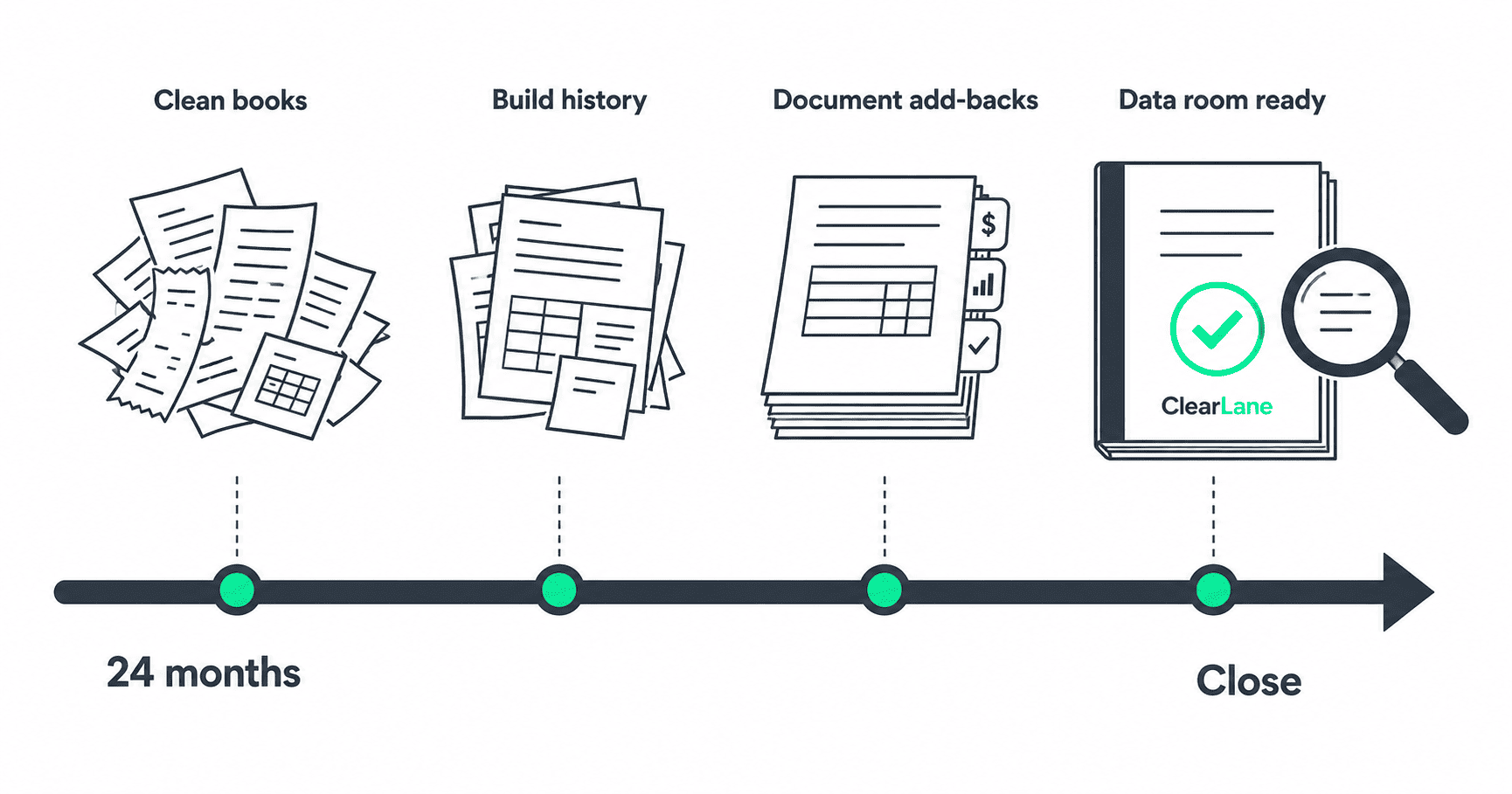
Most freight company owners think about selling two or three years before they say it out loud. The smart ones spend that quiet period doing one thing: getting the records into the shape a buyer will pay for. Valuation gets negotiated off documents, and the documents take time to clean.
Here is what buyers and their advisors actually ask for, and what to have ready before the first serious conversation.
When Should You Start Preparing a Freight Company for Sale?
Twelve to twenty-four months out. Not because the paperwork takes that long to assemble, but because the numbers need history. A buyer looking at clean books, current receivables, and a documented close process wants to see that pattern held for eight quarters, not that it appeared the month the teaser went out. Late cleanups read as staging, and staged records get discounted.
What Do Clean Books Look Like to a Buyer?
Reconciled bank and credit card accounts every month. Transactions categorized consistently in each entity’s own chart of accounts. A month-end close that lands by day 7 with statements to show for it. For multi-entity structures, intercompany balances that reconcile between companies, because a buyer who finds sister-company balances that do not match starts wondering what else does not.
How Do You Document EBITDA Add-Backs From the Sell Side?
Normalization is where sellers win or lose real money. Owner compensation above market, family members on payroll, personal expenses run through the company, one-time costs, related-party rent: each adjustment adds back to earnings, and each earnings dollar prices at a multiple. The difference between an add-back the buyer accepts and one they strike is documentation, assembled while the records are fresh.
For smaller operations priced on owner discretionary earnings, the same rule applies: the schedule of owner benefit needs receipts behind it, not recollection.
Why Is AR Quality a Valuation Lever?
Receivables are often the largest asset transferring. A buyer reads the aging the way a collector would: past-due share, dispute rate, and customer concentration. DSO against the 45 to 65 day freight benchmark is shorthand for how disciplined the operation is, and improving it in the two years before sale does double work: more cash in your pocket now, cleaner asset at the table later. The DSO calculator is a fair place to start that measurement.
What Goes Into the Sale Package?
Three years of per-entity financial statements. Monthly management reports showing a consistent close. Full AR and AP aging with notes on anything past 60 days. The add-back schedule with support. Load-file samples showing rate confirmation to invoice to payment. The carrier compliance file: onboarding standards and ongoing monitoring records. Customer concentration and contract summaries. Buyers move faster and bid stronger when the package answers the second question before they ask it.
If you want the whole list in one place before you start, the sale readiness checklist sets out what a buyer asks a freight company to produce, from monthly financials and documented add-backs through revenue quality, carrier files, and how to lay out the data room.
The 24-month preparation timeline
| When | What gets done | Why it cannot be done later |
|---|---|---|
| 24-18 months out | Books current per entity, monthly close cadence established, add-back log started | Buyers pay for history; eight quarters of consistent closes cannot be created in the last quarter |
| 18-12 months out | AR discipline: aging worked weekly, write-offs taken honestly, slow payers renegotiated or exited | An aging cleaned up in the final months looks exactly like an aging cleaned up in the final months |
| 12-6 months out | Add-backs documented with support, customer contracts checked for change-of-control clauses | An undocumented add-back is priced at zero; an unread contract clause becomes the buyer’s leverage |
| 6-0 months out | Sale package assembled: three years per-entity statements, management reports, the diligence file | This is assembly, not creation. If the pieces exist, this takes weeks; if not, it takes the deal |
The pattern across all four rows: preparation is mostly the absence of last-minute work. Every item is ordinary monthly discipline that happens to have a two-year memory. The complete checkpoint list by vertical is the sale readiness checklist, and the tax side of a sale belongs with your CPA early; IRS guidance on the sale of a business outlines how the asset-versus-stock structure drives what each side prefers.
How ClearLane Helps Sellers Get Ready
This preparation is a records discipline, and it is the same work we run monthly: books kept current per entity, independent reporting packages that build the eight-quarter track record, receivables worked so the aging is defensible, and the add-back schedule maintained as documentation instead of memory. When the process starts, your sale advisors and CPA work from records that hold up, which is what keeps the multiple where the deck promised it.
What Kills Freight Deals Late in Diligence?
Deals rarely die on the first pass of the financials. They die on surprises in week six: a factoring lien nobody mentioned, intercompany balances that do not reconcile between sister companies, revenue that spikes conveniently in the months before the teaser, or a top customer whose contract quietly expired. Every one of those is survivable when the seller discloses it early with documentation. Every one of them is fatal to trust when the buyer finds it first.
The working capital peg cuts both ways for sellers, too. Draining the receivables hard before close, or stretching carrier payables to dress up cash, moves the peg against you and reads as manipulation in diligence. Run the business normally through the process: collect on cadence, pay carriers on terms, and let the records show a machine that runs the same whether anyone is watching. Buyers pay for boring consistency; that is the entire pitch.
The same preparation shortens the process itself. Diligence timelines stretch when every buyer question triggers a records hunt, and every extra week is another week for cold feet, market shifts, or a competing priority to kill momentum. Sellers who answer the standard request list inside days keep buyers moving toward close, and speed protects price at least as much as negotiation does.
Frequently Asked Questions
Twelve to twenty-four months. Buyers discount records that look recently staged, and value records with history. Eight quarters of consistent closes, reconciled accounts, and worked receivables read as an operation, not a presentation.
Three years of per-entity statements, monthly management reports, AR and AP aging with notes, the EBITDA add-back schedule with documentation, sampled load files from rate confirmation through payment, and the carrier compliance file.
EBITDA measures earnings before interest, taxes, depreciation, and amortization, normalized for items that do not transfer. Owner discretionary earnings adds back one full-time owner’s total compensation and benefits on top, and is the common pricing basis for smaller owner-operated companies.
It pressures the price twice. Old receivables transfer at a discount or get carved out of the deal, and a slow collection cycle signals process problems the buyer prices in. Bringing DSO toward the benchmark before a sale is one of the few levers that pays both before and at closing.
We prepare the records layer: current books per entity, reconciled intercompany balances, aging reports, the documented add-back schedule, and the monthly reporting history. Deal structuring, valuation, and legal documents belong to your M&A advisor, CPA, and counsel.
Thinking about an exit in the next year or two? Request a demo and we will show you what buyer-ready records look like for your operation. Or email us at info@getclearlane.com.